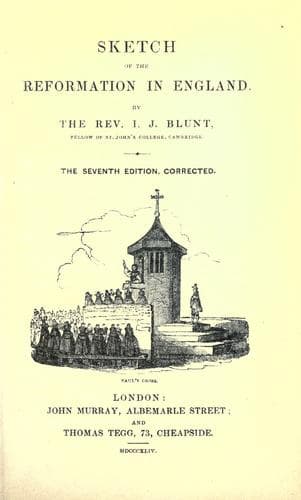
Sketch of the Reformation in EnglandBlunt, John J. (John James)
History
Sketch of the Reformation in England
Blunt, John J. (John James)
Great Britain -- Church history; Reformation -- England
would probably have added its author to the catalogue of his own
martyrs, should excite no small stir among the Catholics, and so it
came to pass. But they weakened the force of their attack by betraying
prematurely the spirit which animated them, sarcastically inquiring,
even before its publication, when the “Golden Legend” was to appear,
and denouncing the “Calendar of Saints,” which they had heard was to
be prefixed to it, as blasphemy against their own. But Fox went on, as
he says, without fear and without favour; and no sooner was Elizabeth
to whom he dedicated, out of the way, than an examination of the book
appeared, by Parsons the Jesuit, in his “Three Conversions of England,”
which has furnished more modern objectors with most of the weapons of
their warfare. But Parsons writes in a temper which defeats itself.
He deals in vague vituperation rather than in specific accusations of
error; or where he ventures upon the latter, he often either wilfully
or ignorantly misreads Fox, as in the vapid pleasantry wasted upon
Joan Lashford, a married maid, as he is pleased to call her;[437] or
he triumphs over him by exposing a flaw in the character of a martyr
with an _eureka_, which the honest martyrologist himself did
not affect to conceal, and for the knowledge indeed of which Parsons
is altogether indebted to him, as where he makes himself merry with
the discordant sentiments of nine martyrs executed together, though
their want of uniformity is a fact which he learns from Fox himself,
who at the same time asserts that their disagreement was in smaller
things only;[438] or he prefers charges against him at random without
troubling himself to ascertain whether there is a foundation for them
or not, as where he accuses him of defacing or destroying the records
of cathedrals, which he had been permitted to use, lest they should
convict him of negligence or fraud, and this not upon investigation of
the fact, but simply, “he presuming it,” as though a charge so serious
was to be an affair of presumption only;[439] or lastly, he comments
upon his author in so fiendish a temper of mind, as would be in itself
enough to satisfy every calm and dispassionate judge that he spoke not
of truth or a love for it, but of mere malice; as where, after debasing
the circumstances of Rowland Taylor’s story throughout, he concludes
with a repetition of his joke about the worms in Hadley church-yard, as
given in Fox, and subjoins, “this noteth Fox in the margin for a goodly
apophthegm of Dr. Taylor, martyr; and with this, he saith he went to
the fire; _where we must leave him eternally, as I fear_;”[440]
and in a similar vein he has the heart to write of Latimer and Ridley,
“they were burned together, each of them taking gunpowder to despatch
himself quickly, as by Fox is seen, which yet is not read to have been
practised by old martyrs, and it seemeth that these men would have
the fame of martyrdom without the pain, and _now they have incurred
Public-domain text, read in full here on John Shaqi.
Reviews
Reviews
No reviews yet
Be the first to share your thoughts on this work.
Elsewhere in the archive
Join the Discussion
Join the discussion
Sign in to leave a comment or review.
Sign InorCreate an account