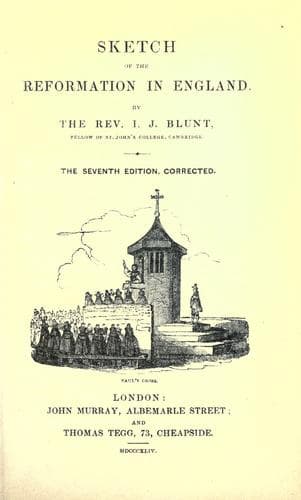
Sketch of the Reformation in EnglandBlunt, John J. (John James)
History
Sketch of the Reformation in England
Blunt, John J. (John James)
Great Britain -- Church history; Reformation -- England
he occasionally beguiled the way--the joy he expressed at hearing that
he was to pass through Hadley, and see yet once before he died the
flock whom, God knew, he had most heartily loved and truly taught--his
encounter with the poor man who waited for him at the foot of the
bridge with five small children, crying “God help and succour thee! as
thou hast many a time succoured me and mine;”--his inquiry, when he
came to the last of the alms-houses, after the blind man and woman that
dwelt there; and his throwing his glove through the window for them
with what money in it he had left--his calling one Soyce to him out of
the crowd on Aldham Common, to pull off his boots and take them for his
labour, seeing that “he had long looked for them;”--his exclaiming last
of all with a loud voice, as though the moral of his life was conveyed
in those parting words, “Good people, I have taught you nothing but
God’s Holy Word, and those lessons that I have taken out of God’s
blessed book, the Holy Bible; and I am come hither this day to seal it
with my blood;”--these, and other incidents of the same story, combine
so many touches of tenderness with so much firmness of purpose--so
many domestic charities with so much heroism--such cheerfulness with
such disaster, that if there is any character calculated to call forth
all the sympathies of our nature, it is that of Rowland Taylor. God’s
blessing is still generally seen on the third and fourth generation of
them that love him; and if Rowland could have beheld the illustrious
descendant which Providence was preparing for him in Jeremy Taylor,
the antagonist of the Church of Rome, able after his own heart’s
content--the first and best advocate of toleration--the greatest
promoter of practical piety that has ever, perhaps, lived amongst
us--he might have humbly imagined that God had not forgotten this his
gracious dispensation in his own case; and had approved his martyrdom,
by raising from his ashes a spirit more than worthy of his name.
Public-domain text, read in full here on John Shaqi.
Reviews
Reviews
No reviews yet
Be the first to share your thoughts on this work.
Elsewhere in the archive
Join the Discussion
Join the discussion
Sign in to leave a comment or review.
Sign InorCreate an account