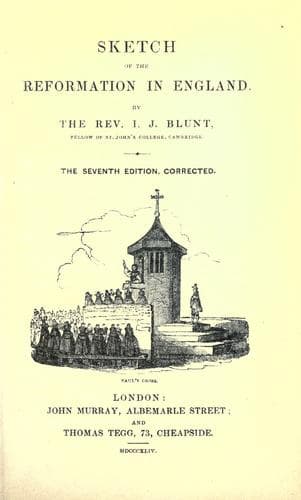
Sketch of the Reformation in EnglandBlunt, John J. (John James)
History
Sketch of the Reformation in England
Blunt, John J. (John James)
Great Britain -- Church history; Reformation -- England
The fate and fortunes of Cranmer, Ridley, and Latimer were so closely
united that their history is a common one. Of Cranmer’s rise and
advancement mention has been made already. Ridley was well born
coming of a good stock in Northumberland; his reputation was great
in Cambridge, where he was first a student and then the Master of
Pembroke College. Henry promoted him to the see of Rochester; and
Edward translated him to that of London. He was a man of vast reading,
ready memory, wise of counsel, deep of wit, and very politic in all
his proceedings. Though abundantly kind to his kinsfolks, he declared
even to his brother and sister, that doing evil they should look for
nothing at his hand; such was his integrity; and when the mother of
Bonner was his near neighbour at Fulham, he gave her a welcome to his
table (an attention which was afterwards but ill returned by her son),
assigning to her a chair of her own; so that even when the king’s
council dined with him, he did not suffer her to be removed, saying,
“By your Lordships’ favour, this place, by right of custom, is for my
mother Bonner;” such was his tenderness. His life, which is probably a
picture of that of the higher ecclesiastics of his time, was conducted
with great regularity. Every morning, as soon as he had put on his
clothes, he prayed in his chamber for half an hour; thence to business
or to study till ten; after which he assembled his household for family
prayers; dinner came next, which, with chess, engaged him for an hour;
when, if there were no suitors, or matters to be transacted abroad,
he returned to his study till five; evening prayers followed, then
supper and his favourite chess; again his books till eleven o’clock,
and so his private devotions performed as in the morning, he ended his
peaceful day. Of the chapters which he selected for the instruction
of his own people (of whom, says Fox, he was marvellous careful), the
13th chapter of the Acts of the Apostles, and the 101st Psalm, were the
most often in his mouth. In his public character Ridley was, doubtless,
one of the brightest lights of the Reformation, yet not such as to
extinguish Cranmer,[446] though some have so accounted him, contrary to
his own modest testimony to the superior knowledge of the Archbishop,
“who passed him,” said he, “no less than the learned master the young
scholar,” and in spite of the numerous acknowledged productions of
Cranmer, and the little we know of Ridley beyond his Examinations,
Treatises, and Letters (all most able indeed), preserved in the pages
of Fox.
Public-domain text, read in full here on John Shaqi.
Reviews
Reviews
No reviews yet
Be the first to share your thoughts on this work.
Elsewhere in the archive
Join the Discussion
Join the discussion
Sign in to leave a comment or review.
Sign InorCreate an account