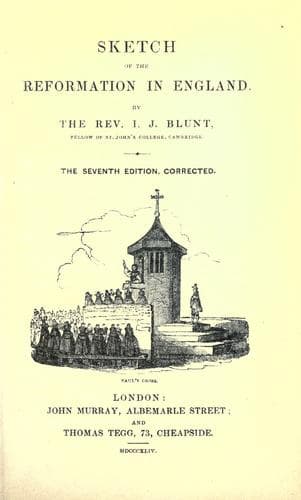
Sketch of the Reformation in EnglandBlunt, John J. (John James)
History
Sketch of the Reformation in England
Blunt, John J. (John James)
Great Britain -- Church history; Reformation -- England
From John Rogers, the first of the martyrs, who suffered on the 4th of
February, 1555, to the five who were burned at Canterbury on the 10th
of November, 1558, and were the last, two hundred and twenty-seven
persons according to some computations, two hundred and eighty-four
according to others, and two hundred and eighty-eight according to a
third authority, perished in the flames.[450] How many more might have
been added to the number of victims, had Mary’s life been spared, it
is impossible to conjecture, but happily those days were shortened;
and on the 17th of November she herself ended a reign of continued
disaster; Calais, which had been in possession of the English since the
battle of Creçy, and then reckoned the jewel of the crown, lost; and
lost apparently because the government dared not call a parliament to
provide means of defence, such was its unpopularity;[451] a heavy debt
contracted, less for national objects than to minister to the wants
of the Spaniards; an exchequer too much exhausted to right itself;
the learned men in exile; the universities a prey to the same Spanish
rapacity;[452] the kingdom at large corrupted by Spanish vices,[453]
and by a return to the law of clerical celibacy;[454] capital offences
greatly multiplied; fifty-two persons being executed at Oxford at one
session;[455] a pestilence depopulating the country to such a degree
as to excite fears of a French invasion by reason of the nation’s
weakness; for the inhabitants of the villages ceased, might Elizabeth
say on her accession; they ceased in Israel, until that I arose, that
I arose a mother in Israel; so that at length it was discovered that
the Roman Catholic cause, for which alone Mary had lived, and would
have been content to die, had by her own measures or misfortunes been
brought to nought; and above all, that the fires of Smithfield had shed
upon it a baleful and disastrous light. Instead of any attempt being
made to alter the succession, though the queen of Scots was at hand
as a candidate for the crown--of such pretensions, too, as would have
been likely to secure her some support at another time--Elizabeth,
Protestant as she was known to be, was advanced to the throne by
acclamation; bonfires lit in the streets before Mary was cold; tables
spread for merry-making in honour of her successor; costly pageants
prepared for her as she traversed the city, the children crying out,
God save Queen Elizabeth![456] the moderate revolted from a religion
which spake of peace, but had shed blood upon the earth like water; and
all parties weary of a reign of terror under which every man’s safety,
to whatever party he belonged, was only upon sufferance.
CHAPTER XIII.
ELIZABETH.--HER ACCESSION.--HER CAUTION.--REFORMATION AGAIN
TRIUMPHANT.--RETURN OF THE EXILES.--JEWEL.--INJUNCTIONS OF
ELIZABETH COMPARED WITH THOSE OF EDWARD.--PROGRESS OF THE
PURITANS.--THE REFORMATION NOT COMPLETED. CONCLUSION.
Public-domain text, read in full here on John Shaqi.
Reviews
Reviews
No reviews yet
Be the first to share your thoughts on this work.
Elsewhere in the archive
Join the Discussion
Join the discussion
Sign in to leave a comment or review.
Sign InorCreate an account