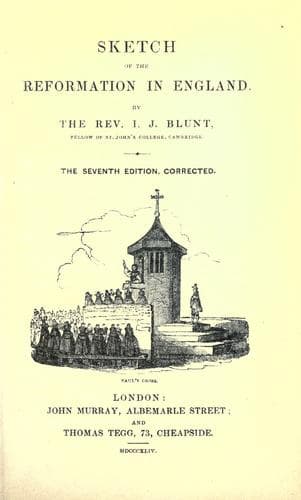
Sketch of the Reformation in EnglandBlunt, John J. (John James)
History
Sketch of the Reformation in England
Blunt, John J. (John James)
Great Britain -- Church history; Reformation -- England
Such was the great agony through which the Reformation was doomed to
pass. But that which thou sowest is not quickened except it die, and
so it proved in this instance. The reign of Mary was the grave of the
cause for a short season, and that of Elizabeth was now to be its
triumphant resurrection. It will not, however, be necessary to pursue
our subject much further, which, from a History of the Reformation,
would soon run into a History of Puritanism, the extreme to which it
degenerated for a while. Into this question it is not our intention
to enter. For the present, little remained to be done, but to repeal
the several laws by which Mary had superseded the acts of Henry and
Edward, and to resume the use of those services and rituals which the
martyrs had provided, and of which the nature and number have been
already told. But Elizabeth proceeded warily. Well as her religious
sentiments were understood, none but the most attentive observer could
have at first detected them in her conduct. A figure of Truth greets
her with a translation of the Bible in its hand; she takes the book
and reverently kisses it. A court buffoon beseeches her to restore to
freedom four prisoners long bound in fetters, Mathew, Mark, Luke, and
John; she answers that she must first endeavour to know the minds of
the prisoners themselves. At her coronation in Westminster Abbey, she
partakes of the mass;[457] on Christmas day, which was about a month
later, she demurs to hear it.[458] The puritans make haste to pull
down the images; she bids them hold their hand. Unlicensed preachers,
be they of what denomination they may, Catholics or Protestants she
silences alike. The marriage of the clergy, much as the measure was
desired by the leaders of the Reformation, she refuses, connives at,
at last reluctantly concedes. She offends the zealots of both parties,
for she openly espouses the cause of neither;[459] but she makes that
party her own, which represents the sober, the stable, the somewhat
phlegmatic good sense of the English people; a party without which
no government, however brilliant, can be safe; and with which none,
however unattractive, can be long in danger. Such policy was natural to
herself;--“My sweet sister _Temperance_,” was the name by which
her brother loved to call her; and, moreover she had been nursed in the
school of caution, and for years one word or deed of indiscretion might
have cost her her head. Such policy, too, was after the heart of Cecil,
perhaps the sagest of her counsellors, who now taught his mistress
to thread her way, as he had hitherto threaded his own, through most
dangerous and difficult times, with the sagacity of a wizard. The
outset of Elizabeth’s reign, indeed, was perhaps the masterpiece of
his tactics; and years afterwards, when the crisis was passed and the
Reformation established, he appealed to that period, as well he might,
in proof of his successful devotion to the cause of truth.[460] Still
Public-domain text, read in full here on John Shaqi.
Reviews
Reviews
No reviews yet
Be the first to share your thoughts on this work.
Elsewhere in the archive
Join the Discussion
Join the discussion
Sign in to leave a comment or review.
Sign InorCreate an account