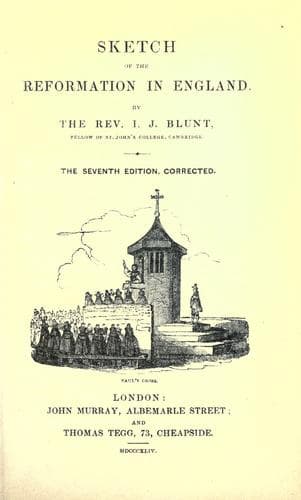
Sketch of the Reformation in EnglandBlunt, John J. (John James)
History
Sketch of the Reformation in England
Blunt, John J. (John James)
Great Britain -- Church history; Reformation -- England
Elizabeth was working her way underground, and by measures which
whilst they did not provoke notice, would not fail to produce fruits.
Thus, though she would not exclude Roman Catholics from her privy
council, she would yoke them with such colleagues as were friendly to
the Reformation, and were at the same time of talents so extraordinary
as would readily obtain the mastery in debate. Though she would not
weed out of the commission of the peace Roman Catholic magistrates, she
would regulate her new appointments with a view to serving the cause
she had secretly at heart. She would not compel, or attempt to compel,
a Roman Catholic parliament by force to make the laws she desired,
but she would take care to influence the elections in such a manner
as to secure the return of members who would do so. Her first object
appears to have been to soothe the country: to maintain the authority
of the law, be it as yet what it might; to establish her own position
as monarch; and thus to possess herself of a basis on which she might
proceed to build, at her leisure, the permanent prosperity of her realm.
Her parliament assembled, and never did a parliament meet under
circumstances more imperative: to its wisdom it was left to order and
settle all things upon the best and surest foundations; and accordingly
it passed the two great acts by which the alliance between church and
state was established, those of Supremacy and Uniformity; neither of
them, indeed, now enacted for the first time, but both statutes of
Henry or Edward, with certain amendments, revived.
Public-domain text, read in full here on John Shaqi.
Reviews
Reviews
No reviews yet
Be the first to share your thoughts on this work.
Elsewhere in the archive
Join the Discussion
Join the discussion
Sign in to leave a comment or review.
Sign InorCreate an account