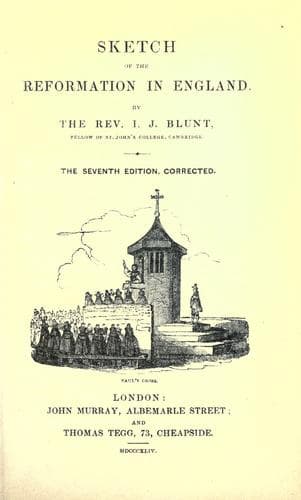
Sketch of the Reformation in EnglandBlunt, John J. (John James)
History
Sketch of the Reformation in England
Blunt, John J. (John James)
Great Britain -- Church history; Reformation -- England
by adversity, and in many instances found to possess, under a mean
aspect, perhaps, a genius that was vast. Out of these were drafted
many recruits; Jewel, the Coryphæus of them all, a man, indeed, of
matchless learning, which he nevertheless wields, ponderous as it is,
like a plaything: of a most polished wit; a style, whether Latin or
English, the most pure and expressive, such as argues a precision in
the character of his ideas, and a lucid order in the arrangement of
them, quite his own. His “Apology” and his “Defence” of it, were the
crowning works of the Reformation, and may be regarded, on the whole,
as those in which its doctrines are put upon record by one the best
qualified of all men to assert them with authority, both from his
intimate knowledge of the subject, the personal intercourse he had
enjoyed with its chief promoters, and the favourable moment at which
he wrote. But whilst some of these exiles were thus the pillars of
their church, others were the reeds. Such were Cartwright, appointed
to the Margaret professorship in Cambridge, and Sampson, to the
deanery of Christ-church. What could come of these ministers, or of
others like to these, but a plentiful harvest of non-conformity in the
generation of students brought within the influence of their example
and teaching; destined themselves to impart it in their turn to the
several parishes throughout England in which their lots might happen
to be cast? Here, then, was a schism, violent enough to endanger even
a long-established church, much more one so recently settled as our
own. But besides the Sampsons and Cartwrights, extravagant schismatics,
there was another and a larger class behind, good men indeed, but,
perhaps, too gentle for the times, the class of lukewarm churchmen, who
still strengthened the hands and ministered to the purposes (however
unwittingly) of spirits more determined than themselves.[466] Such
was Pilkington, bishop of Durham,[467] and even Grindal, bishop of
London,[468] both Marian exiles, and neither of them very cordial
fellow-workers with Parker, himself not an exile. For here was the
origin of these religious distinctions: the former leaning to the
puritan;--Grindal himself being the Algrind of Spenser, whose praises
of him bespeak the party with which he was identified;[469]--the latter
leaning to the Roman Catholic. Nor did the division expire with this
generation; Abbot and Laud still presenting the same contrast in the
next, when the church was upon the eve of that dissolution which was
the issue of the whole. Still the puritan principle, violently as it
worked, subversive as it was of much that was innocent and much that
was holy, had this to redeem it, that it purged out of the kingdom,
effectually and for ever, the popery (we can use no other word to
express our meaning) which lingered in its veins, and which, without
the application of a strong antidote, might once more have penetrated
to its vitals.
Public-domain text, read in full here on John Shaqi.
Reviews
Reviews
No reviews yet
Be the first to share your thoughts on this work.
Elsewhere in the archive
Join the Discussion
Join the discussion
Sign in to leave a comment or review.
Sign InorCreate an account