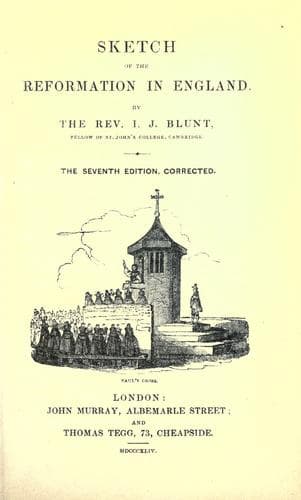
Sketch of the Reformation in EnglandBlunt, John J. (John James)
History
Sketch of the Reformation in England
Blunt, John J. (John James)
Great Britain -- Church history; Reformation -- England
For the spirit of popery, properly so called, always
active, and now the more so from the ill-disguised claims of the Queen
of Scots to the throne of England, had been recently recruited, it
must be remembered, by the institution of the order of Jesuits, which,
springing up in the age of the Reformation, aimed at directing the
general movement, both in religion and politics, to the advantage of
the Bishop of Rome, whose devoted servants they professed themselves.
The rules, the activity, and the learning of this society rendered
them formidable to any Protestant state, and added not a little to
the perplexities of Elizabeth’s position, who, whilst she feared the
levelling and anti-monarchical principles of the Puritans, otherwise
her natural allies against these champions of the Pope, was in still
greater jeopardy from a hostile order, universal in its influence,
secret in its operations, sagacious as herself in its councils; and if
at length her government proved that it bore not the sword in vain, but
smote with somewhat of a ruthless hand, it was rather in self-defence
against political agitators that it so acted, than in violation of
the rights of conscience. For certainly the severity did not begin
till after her subjects had been absolved from their allegiance by a
Pope’s bull,[470] neither did it ever manifest itself against woman or
child; a distinction this, between the punishments of Elizabeth and the
persecutions of Mary, sufficient in itself to point out that it was
the disloyalty, and not the creed, of the parties that drew upon them
the vengeance of the Queen; and to confirm the assertion of Cecil in
his “execution of justice,” that no one was put to death by Elizabeth
for his religion only,[471] as well as a similar vindication of her
policy advanced with much detail in a letter of Walsingham’s--a policy
which, he contends, was ever regulated by two rules, “to deal tenderly
with consciences, but not to suffer causes of conscience to grow to be
matters of faction.”[472]
Public-domain text, read in full here on John Shaqi.
Reviews
Reviews
No reviews yet
Be the first to share your thoughts on this work.
Elsewhere in the archive
Join the Discussion
Join the discussion
Sign in to leave a comment or review.
Sign InorCreate an account