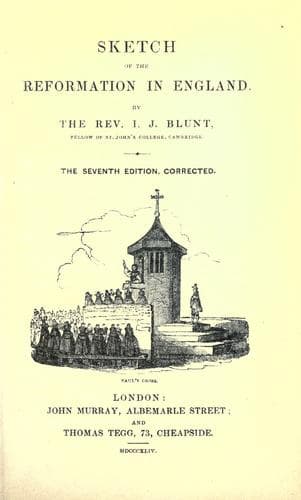
Sketch of the Reformation in EnglandBlunt, John J. (John James)
History
Sketch of the Reformation in England
Blunt, John J. (John James)
Great Britain -- Church history; Reformation -- England
the growth of heresies, contrary to the faith of Christ and his Holy
Spirit; still a foretaste of the speculative imaginations of the next
century. Another against disturbing the congregation in the time of
sermon; a practice afterwards so common, and of which Bishop Bull’s
debate with the brawling Quaker is a characteristic instance.[474]
A third, for the better regulation of singing in churches; not,
indeed, absolutely forbidding the use of music, but reducing it to
much greater simplicity; a concession, as far as it went, to the
same party, who would willingly have ejected all organs, and allowed
no psalmody whatever, but such as was strictly congregational.[475]
Meanwhile the secret of this growing strength of the puritan cause
is discovered in other allusions, contained in the same injunctions,
to the penury of the church, and the ignorance of its ministers; the
natural effect of the late pillage and misapplication of its revenues:
for here we encounter, not without some feelings of humiliation, such
provisions as these (_ex pede Herculem_): that no priest shall
marry without permission given by the bishop and two justices of the
peace living next to the place where the woman hath made her most abode
before marriage, nor without the good will of her parents or next
kinsfolk; or, for lack of such, of “_her master or mistress where
she liveth_.” And again, that “such as are but _mean readers_
shall peruse over before once or twice the chapters and homilies, to
the intent they may read to the better understanding of the people,
and the more encouragement of godliness.” This is a glimpse of a sad
picture; but it is such as the sketch given in a former chapter[476]
of the condition of the clergy under King Edward must have prepared
us to expect. The Reformation was still too recent an event, and had
been effected by means too violent, for the great good that was in it
to have developed itself. The fountain had been thoroughly troubled,
and time was wanting for it to defecate, as well as an infusion,
perhaps, of some fresh elements that should expedite the process of
precipitation. These Cranmer would have supplied had he been allowed
to complete his own idea. But his untimely death, and the selfish
passions of men too strong for him, thwarting him whilst he lived,
scanted the Reformation of much that should have belonged to it, and
consigned it to posterity a noble but still an unfinished work--a
work in which there is every thing to admire, and yet something to
desiderate.
Public-domain text, read in full here on John Shaqi.
Reviews
Reviews
No reviews yet
Be the first to share your thoughts on this work.
Elsewhere in the archive
Join the Discussion
Join the discussion
Sign in to leave a comment or review.
Sign InorCreate an account