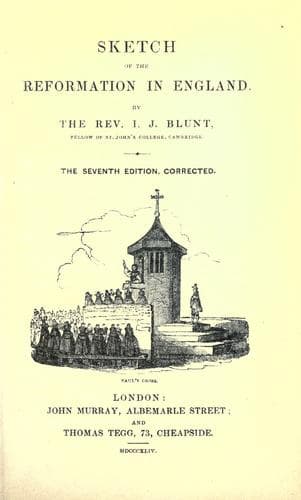
Sketch of the Reformation in EnglandBlunt, John J. (John James)
History
Sketch of the Reformation in England
Blunt, John J. (John James)
Great Britain -- Church history; Reformation -- England
Thus it has been said that the Reformation left the church without
_discipline_; a defect which our commination-service confesses and
laments; but it was one from which the Roman catholic church itself
was not exempt, for the rivalry which existed between the secular and
regular clergy, and again between the several orders of the latter,
was, as we have seen, fatal to discipline. Still, whatever the defect
was, it was not the fault of the reformers that it was suffered to
remain. The canon laws were, indeed, no longer strictly applicable
to the church, constructed as it now was: but an attempt was made
to accommodate them, or to substitute for them such as were thought
better. A code, which he called Reformatio Legum Ecclesiasticarum,
was drawn up by Cranmer, consisting of fifty-one titles, with an
appendix, after the manner of the Digest of Justinian. It underwent
many revisions in private during the reigns of Henry and Edward, but
was not produced. It was revived, with a view to its legal enactment,
by the Puritans in the lower house of parliament under Elizabeth;
but the Queen thought it trenched upon her supremacy, and would not
hear of it. It was reprinted, and no more under Charles I., and was
suggested once again to public notice by Bishop Burnet.[477] All,
however, would not do; it fell to the ground; whether originally from
the mere accident of the deaths of Henry and Edward before it was fully
matured; whether from the difficulty of maintaining penal statutes in
general in a church founded upon the principles of the Reformation; or
whether, as some have thought, from the extreme severity of the code
itself. That the latter circumstance was the cause of its non-enactment
it is difficult to believe; for, severe as it may seem to us, and as
it undoubtedly is, the distinction which is made in it between the
essential and unessential doctrines of Christianity, and the exclusive
application of the capital laws against heresy to the former, was the
first instance of any such discrimination being exercised.[478] and
may be fairly considered as a step in the progress of the principles
of toleration; as the mitigation rather than the approval of penal
excesses; for so little was that age prepared to revolt at the
provisions laid down in it, that Bishop Jewel, who must have ranked
rather with the liberal than the dogmatical party of his own day; who
had lived in exile at Frankfort, a liberal school; himself, therefore,
a victim of persecution; and who wrote many years after Cranmer; seems
to approve the same theory of punishment, and perhaps the same scale of
it; for whilst he vindicates freedom of opinion up to a certain point,
still such as have a _wicked_ opinion either of God the Father, or
of Christ, or of the Holy Ghost, or of any other point, of Christian
religion, they being confuted by the Gospel of Christ, he would plainly
pronounce detestable and damned persons, and would defy them even unto
Public-domain text, read in full here on John Shaqi.
Reviews
Reviews
No reviews yet
Be the first to share your thoughts on this work.
Elsewhere in the archive
Join the Discussion
Join the discussion
Sign in to leave a comment or review.
Sign InorCreate an account