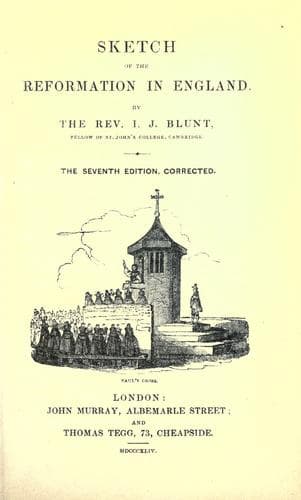
Sketch of the Reformation in EnglandBlunt, John J. (John James)
History
Sketch of the Reformation in England
Blunt, John J. (John James)
Great Britain -- Church history; Reformation -- England
beef amongst four, a few potage made of the same, with salt and
oatmeal, and nothing else:--at five in the evening they had a supper
not much better than the dinner; and, before they went to bed, which
was at nine or ten, being without fire, “they were fain to walk or
run up and down half an hour to get a heat on their feet.” Such was
the condition of what students there were in Cambridge in the days of
Edward the Fifth.[486] Now this declension in the means of national
instruction was the more calamitous because it happened at a moment
when the thirst for knowledge was becoming intense, and when it was
more than commonly desirable that it should be slaked from cisterns
of wholesome waters. Of this our reformers were aware; but again they
were baffled, both they and their king. The larger benefices were,
indeed, charged with the support of one scholar at the university
for every hundred pounds of their annual value: but this was a very
limited provision for the wants of the times.[487] The chantry lands
would have furnished a considerable, perhaps a sufficient, fund for
the purpose, and Edward did so apply them in part, and would gladly
have done so more extensively; but they were devoured by the nobles,
and the moment for royal endowments went by. Happy would it have been,
had it been otherwise. Such grammar schools as he would have planted
over England would have been found “seminaries of sound learning,” and
(what was the first consideration of the founder) “of _religious_
education.” They might have raised up a more literate clergy. They
might have checked, perhaps, the rising extravagances of the Puritans.
They might have sustained the church by the direction they would
have given to public opinion; and dispersed the storm which already
threatened, by conducting, quietly and not unfruitfully, to the earth,
the fierce elements with which the political and religious atmosphere
was already so heavily charged. For they would have been the natural
feeders of the church of England; the visitor, probably one of its
prelates; the teachers, its more learned ministers; the prayers, those
of its services; the catechism, its manual of doctrines--that which
Dean Nowell composed in Latin, and which was afterwards translated
into Greek by Dr. Whitaker, his nephew, for the express use of such
schools, having been approved in convocation, and been acknowledged to
speak the authorised language of the reformers. A few such schools King
Edward did establish, as we have said; but in numbers quite inadequate
to the demands of the nation, which must have been abandoned to gross
ignorance, and to the delusions of every theological empiric (which
was in a great degree the case after all), but for the many private
foundations, still however very insufficient, by which the reign of
Elizabeth, who incorporated them, was distinguished. For these, the
country was indebted to the generous efforts not of ecclesiastics only,
Public-domain text, read in full here on John Shaqi.
Reviews
Reviews
No reviews yet
Be the first to share your thoughts on this work.
Elsewhere in the archive
Join the Discussion
Join the discussion
Sign in to leave a comment or review.
Sign InorCreate an account