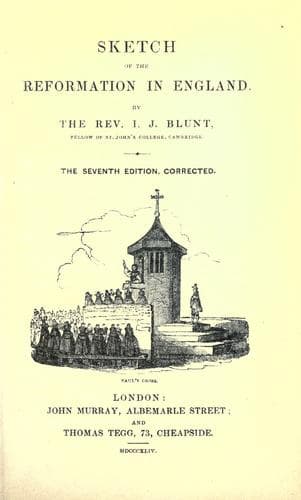
Sketch of the Reformation in EnglandBlunt, John J. (John James)
History
Sketch of the Reformation in England
Blunt, John J. (John James)
Great Britain -- Church history; Reformation -- England
Another particular in which the Reformation was left incomplete, was
in a provision for the sufficient education of the people. The demand,
indeed, for education had not hitherto been great; few boys but such
as were intended for ecclesiastics were made scholars; so that even
Latimer reckons the sons of great laymen or esquires, as he calls
them, interlopers in the universities.[482] The churchman, and no
other, was the clerk; and the convent was in general the academy; it
was so, at least, in a _hundred_ instances, if we understand an
expression used by the speaker of the lower house, in the fourth year
of Elizabeth, aright; who, in his address to the Queen laments the loss
of such a number of places of education.[483] Schools, therefore, in
the present sense of the word, there were few; not more than three,
we believe, in all London. And when Dean Colet founded that of St.
Paul’s on the eve of the Reformation, it was a thing regarded with
some jealousy.[484] Hence it probably was, that the numbers sent to
Oxford and Cambridge (the two great national schools, as they were
then considered) were so extraordinary--thousands where there are
now hundreds; and that the age of the students was so tender. For
on the rapid multiplication of foundation schools throughout the
country in the century after the Reformation, the character of the
universities, we shall find, became changed; the number of students
diminishing, in spite of an increasing population, and the age at
which they entered greatly advanced. Milton’s is said to be the last
instance of corporal punishment in either university--a tradition
which, whether true or false as to the individual, may serve to date
the period of the transition from the past to the present system of
academical education. But of the few schools that existed before the
Reformation, some were seized and sold by the rapacious courtiers,
particularly under the feeble reign of Edward; here was one channel of
education cut off:--the convents were destroyed; here was another:--the
universities were decayed; here was a third:--they were decayed,
because the yeomen who might have been able to send their children
to a school in the neighbourhood, if there had been one, were quite
unable, from a disastrous change in their circumstances, to send them,
as they often had done heretofore, to Oxford and Cambridge:[485] an
education so remote, frugal as the times then were, being comparatively
costly, and such as rendered even the ten groats which Jewel bestowed
upon Hooker, when he called upon the good bishop on his way to his
college on foot, not unwelcome. They were still further decayed from
the same cause as the schools; powerful individuals intercepted and
appropriated their revenues--accordingly very many students were
actually unable to stay “for lack of exhibition and help,”--others did
indeed stay, but in extreme penury. They rose in the morning between
four and five o’clock; at ten they dined, having “a penny piece of
Public-domain text, read in full here on John Shaqi.
Reviews
Reviews
No reviews yet
Be the first to share your thoughts on this work.
Elsewhere in the archive
Join the Discussion
Join the discussion
Sign in to leave a comment or review.
Sign InorCreate an account