Sketch of the Reformation in EnglandBlunt, John J. (John James)
History
Sketch of the Reformation in England
Blunt, John J. (John James)
Great Britain -- Church history; Reformation -- England
Another defect imputed to the Reformation is the inadequate support it
provided for the lower orders of the clergy. Four thousand livings,
and upwards, of less than one hundred and fifty pounds a year each,
many very far less, with no parsonage houses whatever, or with such
as the most Sabine economist would pronounce unfit for a clergyman to
occupy;--this is the forlorn condition, as to temporals, in which the
church has stood for a long season; a condition to which it could not
have been reduced, had even a portion of the vast revenues dispersed
at the Reformation been husbanded, and applied to the legitimate
purpose of bettering the situation of the inferior clergy. This,
Cranmer most earnestly desired; but his entreaties and regrets were
alike unavailing. The evil continued, and Jewel took up the subject
in his turn; and pressed the redress of it upon Elizabeth and her
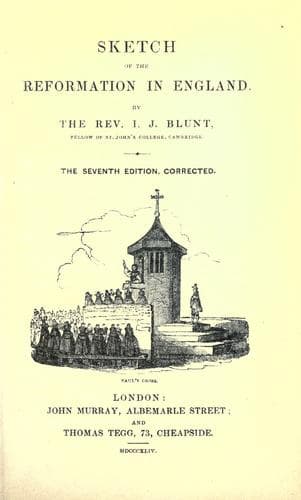
nobles, in his sermons at Paul’s Cross (very curious pictures of the
times); but the spoil was then divided, and restitution was looked for
in vain.[488] Laud made another effort; one of whose projects it was
to move Charles for a grant to buy in impropriations, two of which he
hoped thus to redeem every year; but his chance of success best appears
from the very intention (of which the record was found in his diary)
being made matter of charge against him at his trial. Had the exertions
of these prelates been effective, the very great, but, as things at
present stand, the necessary evil of pluralities and non-residence
would have been prevented, or left without cause or excuse. As it is,
to proscribe the pluralist altogether, would in many cases, be to visit
with utter poverty the meritorious labourer in the vineyard, him and
his little ones; and to insist, in all cases, upon residence, would be,
in some, to say that the village handi-craftsman more lettered than
his fellows, should be again the officiating minister, as he once was
in Edward’s days, and as he was forbidden to be, from the mischief it
occasioned, under Elizabeth. The evil of which we speak is grievous;
but it has been and is decreasing. By help of Queen Anne’s bounty, of
which the origin and history has been briefly told already, a sum of
money advanced for the augmentation of a small living is met with an
equal sum, when the whole is invested in land, so soon as land can be
found; and thus is the income of the poor incumbent improved. And,
by a modern and excellent act of the legislature, empowering him to
mortgage his benefice to the amount of two years’ income, and to bind
his successors as well as himself for the gradual liquidation of the
debt, he is enabled to build a new house, or make an old one habitable;
and thus is his residence encouraged. The beneficial operation of these
two instruments of gradual church reform is more and more manifest
every day. By virtue of them the modest but not mean parsonage is
beginning to appear in many rude and secluded hamlets where before
Public-domain text, read in full here on John Shaqi.
Reviews
Reviews
No reviews yet
Be the first to share your thoughts on this work.
Elsewhere in the archive
Join the Discussion
Join the discussion
Sign in to leave a comment or review.
Sign InorCreate an account