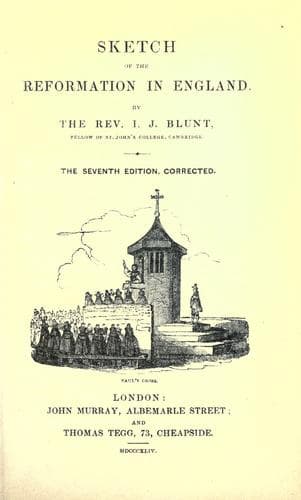
Sketch of the Reformation in EnglandBlunt, John J. (John James)
History
Sketch of the Reformation in England
Blunt, John J. (John James)
Great Britain -- Church history; Reformation -- England
there had been none: and the advantages of a pastor on the spot,
frugal, indeed, of necessity, but carrying with him the respect which
superior intelligence commands, and the sympathies of those amongst
whom he walks not unseen; whose adviser he is in difficulties, and
peace-maker in disputes; whose houses he visits in sickness and sorrow,
and whose children he teaches the way in which they should go;--these
charities, the attendants upon a resident ministry, are diffusing
themselves over districts where they were once unfelt, and attaching
the inhabitants to our church by the strongest of all ties, “the
cords of a man.” But, alas! the residence must depend upon the house,
and the house upon the income of the benefice: to the improvement of
the latter, therefore, should our efforts be first directed, as the
moving-spring of all; and if, by any equitable means, the fund at the
disposal of the commissioners of Queen Anne’s bounty could be enriched,
great would be the gain. But if lay patrons of small livings, where
they happen to be also impropriators, could be induced to co-operate
with the clergy for this same great object, which is national; if the
generous spirit which animated their fathers, during half a century,
after the Restoration,[489] when they had learned in the day of
suffering the value of their church, and in the moment of joy at its
re-establishment welcomed it with gifts,--if that spirit would stir
in them also; if they would re-annex, as was then done so commonly,
to these their own livings (we ask no more), some portion, however
small, of the tithes which they enjoy, and which were all wrung from
the church; a sacrifice which, from its amount, would scarcely be felt
by many patrons, and which would not, in fact, be an alienation of
so much property, but rather a regulation of the course in which it
should run; a reduction, perhaps, of fifty or a hundred pounds a year
from an elder brother’s rent-roll, to the augmentation to the like
amount of a younger brother’s benefice;--if the patron and impropriator
could be persuaded thus to act, the necessity for non-residence and
pluralities would be still more rapidly diminished, and the national
church would soon be placed in a more impregnable position than she has
ever assumed in this particular, either since the Reformation or before
it. And without urging higher motives, without urging even the feudal
nature of all property in one sense, held, under God, the Lord of all,
on condition of suit and service to be done, and not as an absolute
possession to be dealt with altogether according to the pleasure of the
occupant--without pressing this consideration (which is nevertheless
a sound one), we shall be borne out in saying, that the possessor of
property best secures the permanent enjoyment of it by securing a
righteous population to his country; that the respect or contempt of
the laws of the land in our parishes, and particularly in our rural
Public-domain text, read in full here on John Shaqi.
Reviews
Reviews
No reviews yet
Be the first to share your thoughts on this work.
Elsewhere in the archive
Join the Discussion
Join the discussion
Sign in to leave a comment or review.
Sign InorCreate an account