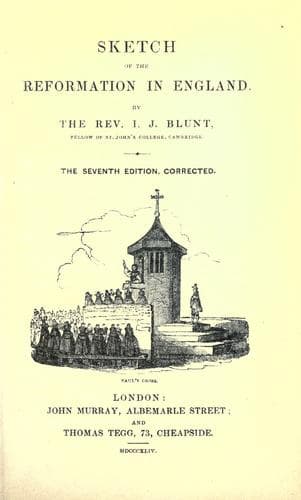
Sketch of the Reformation in EnglandBlunt, John J. (John James)
History
Sketch of the Reformation in England
Blunt, John J. (John James)
Great Britain -- Church history; Reformation -- England
[223] Ibid. xviii. 8.
[224] Deut. xxv. 5.
[225] l Kings, ii. 17.
[226] Joseph. Antiq. lib. xviii. § 6, p. 807.
[227] Contemplations, lib. xii.
[228] The Querist, § 198. A work containing perhaps as much genuine
humour, as many sagacious guesses at the real causes of various social
and political evils affecting commonwealths, Ireland in particular (for
it is written for the benefit of that country), and as many shrewd and
practical hints for the removal of them, as any in our language.
[229] Burnet, Hist. Reform. lib. i. 125. fol.
[230] Dr. Lingard asserts that there were few instances of the see
of Canterbury being filled so soon after a vacancy. Yet Archbishop
Bredwardin died August 26, 1349, and Islip was appointed his successor
by a papal bull, dated October 7, 1349, and was consecrated December
20th. Archbishop Arundel died February 19 or 20, 1413; Chichelè
succeeded March 4, and received his pall in July. Chichelè died
April 12, 1443; Stafford succeeded him by a bull dated May 15, and
was consecrated in August. Stafford died in June or July 1452; Kemp
succeeded by bull dated July 21, and on September 22, received his
cross. Kemp died March 22, 1543, Bourchier was elected April 22, and
received the bull of confirmation August 22. Langton died January 27,
1500; Dean was elected in April, and confirmed May 26.
See Mr. Todd’s Introduction to Cranmer’s Defence of the Sacrament, p.
xxxvii.
[231] Mr. Ellis remarks, (Original Letters, vol. ii. p. 47,) that upon
Wolsey’s fall, Henry pressed the chancellorship upon Cranmer, more
than once, before he offered it to Sir Thomas More. Had it been so,
the refusal would but have been of a piece with the rest of Cranmer’s
private history; and, accordingly, we had once adduced this fact as a
further argument of his unambitious spirit--but it has been pointed out
to us by a high authority in ecclesiastical history, that Mr. Ellis has
here mistaken Warham for Cranmer. Both the words of Erasmus’s letter
(which is the reference, Epist. lib. xxvi. 55,) and its date prove this
to be the case. It is there said, that the chancellorship was offered
more than once to the _Archbishop of Canterbury_, and that he
excused himself on the plea of _age_. Now, the date of the letter
being January 1531, Cranmer was not then Archbishop, but Warham who
died in August 1532; moreover, Cranmer was at that time only in his
42d year, and therefore could not possibly consider himself too old
for the office. We notice a solitary error, for the sake of having an
opportunity of expressing our thanks to Mr. Ellis, for the invaluable
materials for English history which his researches have brought to
light and the very instructive notes with which they are accompanied.
[232] Strype’s Cranmer, 456.
Public-domain text, read in full here on John Shaqi.
Reviews
Reviews
No reviews yet
Be the first to share your thoughts on this work.
Elsewhere in the archive
Join the Discussion
Join the discussion
Sign in to leave a comment or review.
Sign InorCreate an account