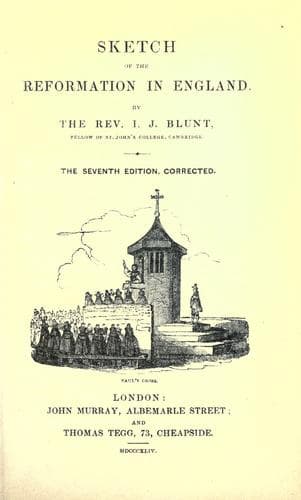
Sketch of the Reformation in EnglandBlunt, John J. (John James)
History
Sketch of the Reformation in England
Blunt, John J. (John James)
Great Britain -- Church history; Reformation -- England
[233] The _publicity_ of this proceeding is clearly proved in Mr.
Todd’s Life of Cranmer, vol. i. p. 65. It is so far of importance,
as it shows that the three Bishops--Lincoln, Exeter, and St. Asaph,
(the last of them, Dr. Standish, a most zealous catholic,)--who were
fixed upon to consecrate Cranmer, had the opportunity of refusing him
consecration had they thought proper.
[234] Id. p. 17.
[235] Strype, Cran. p. 17.
[236] See Burnet, Hist. of Ref. vol. i. p. 123. fol. where the oaths
are given at full.
[237] Cranmer, when examined before the commissioners at Oxford,
touching the supremacy, urges with great force this same argument
against the Queen herself, whose oaths to the state and to the pope
being so repugnant.--“She must needs be forsworn to the one.”--Fox,
vol. iii. p. 660.
[238] See Jewel’s Defence of the Apology, p. 634, fol.
[239] 2 Cor. xi. 5.
[240] xlix. 23.
[241] 2 Kings, xxii.
[242] See Jewel’s Defence of the Apology, p. 571.
[243] See The Icon Basilike, chap. xvii., quoted by Warburton in his
“Alliance between Church and State.”
[244] See Sozomen, Hist. Eccles. lib. i. c. xvii. Euseb. de Vit.
Constantin. iii. c. vii. Theodoret, Hist. Eccles. i. c. vii.
[245] In the time of Henry III., sixty-four abbots and thirty-six
priors were called to parliament; but Edward III. reduced them to
twenty-five abbots and two priors: two abbots were added afterwards;
so that there were in all twenty-nine who enjoyed this honor till the
dissolution.
[246] Fox’s Acts and Mon. ii. 282.
[247] Knight’s Life of Dean Colet, p. 61.
[248] See Ellis’s Original Letters, vol. ii. pp. 71. 77. vol. ii. p.
130, Second Series.
[249] See an Account of the Ancient and Present State of Shrewsbury
12mo. p. 107.
[250] Milton.
[251] See Sir H. Spelman’s History and Fate of Sacrilege, p. 229.
[252] Kennett on Impropriations, p. 165.
[253] Strype, Cranmer, p. 412.
[254] Kennett on Impropriations, p. 131.
[255] Dedicat. of Latimer’s Sermons, vol. ii. p. ix.
[256] Kennett, pp. 158. 184.
[257] History and Fate of Sacrilege, p. 243.
[258] Walton’s Life of Hooker. Eccl. Biog. vol. iv. p. 236.
[259] Fuller’s Holy and Prof. State, p. 239.
[260] Kennett’s Impropr. p. 438.
[261] Id. 184. Prov. xx. 25.
[262] Spelman, p. 297.
[263] Neal, History of the Puritans, vol. iv. p. 55.
[264] Kennett, p. 126.
[265] Strype makes the number 20; Collier, 40. Collier, ii. 19.
[266] Latimer’s Sermons, v. i. p. 87.
[267] See some curious traits of Cromwell’s real character collected
from his own memoranda, and other authentic sources, in Ellis’s
Original Letters, vol. ii. p. 116, second series, and again, p. 162:
a list of the grants of lands made to him by Henry, is given p. 171.
See also Hallam’s Constitutional History, 8vo. i. 96.; and Sir James
Mackintosh’s History of England, ii. 228.
[268] Burnet, ii. 45, 46.
[269] Id. i. 189, 190.
[270] Id. i. 227.
[271] Levit. xxv. 23.
Public-domain text, read in full here on John Shaqi.
Reviews
Reviews
No reviews yet
Be the first to share your thoughts on this work.
Elsewhere in the archive
Join the Discussion
Join the discussion
Sign in to leave a comment or review.
Sign InorCreate an account