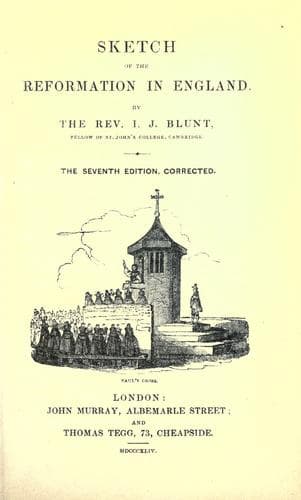
Sketch of the Reformation in EnglandBlunt, John J. (John James)
History
Sketch of the Reformation in England
Blunt, John J. (John James)
Great Britain -- Church history; Reformation -- England
voice against the King’s supremacy whilst the question of the divorce
was in progress. The friars did not stay at home like the easy and
well-conditioned monks, but had to forage for a living. “Go not from
house to house,” though a text uttered, as it might seem, with almost
a prophetic reference to them, they found it convenient to overlook.
Whatever opinions, therefore, they entertained, they had the power of
putting in extensive circulation; now that they were disaffected, this
facility became doubly dangerous. Then they were the most vulnerable
of the orders; their corruptions were the grossest. Their vagrant
habits threw them amongst temptations, whilst they at the same time
withdrew them from wholesome restraints. Abroad they were notorious for
intrigues in the hospitable families of the peasants and artisans who
received them; and at home they had a treasury of lies, very profitable
to themselves whilst their credit was good, but more profitable to
their enemies when the fictitious nature of the capital with which they
traded was exposed. The Rood of Grace, which would hang its lip when
silver was offered to it, and shake its beard merrily when the offering
was of gold, was for a time an exchequer; but when the profane hand
of a Thomas Cromwell had once opened the figure at Paul’s Cross, and
displayed to the good citizens of London the wires by which it had been
worked, indignation took the place of credulity, and the craftsmen, to
whom it had brought no small gain, were justly scandalised. Moreover,
the destruction of these lesser houses did not touch in a very tender
place the powerful and privileged classes of society. Younger brothers
were provided for in the wealthy abbey, but not in the friar’s hostel.
It was a war upon the weak (so far as property was concerned,) and
at a time when commerce and manufactures had not taught the weak but
the many their value and their strength; and therefore it was a step
attended with less danger. Lastly, it was a measure that served very
well as a feeler for one still greater which was behind, but which was
as yet studiously disavowed, the suppression of all the monasteries and
convents great and small; it was the bristle which made a way for the
thread.
Public-domain text, read in full here on John Shaqi.
Reviews
Reviews
No reviews yet
Be the first to share your thoughts on this work.
Elsewhere in the archive
Join the Discussion
Join the discussion
Sign in to leave a comment or review.
Sign InorCreate an account