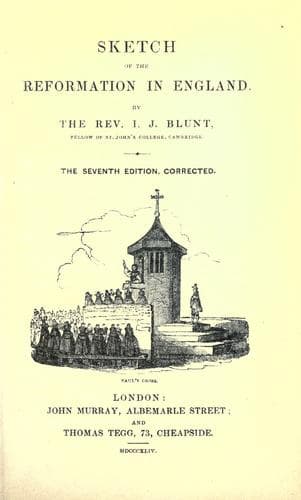
Sketch of the Reformation in EnglandBlunt, John J. (John James)
History
Sketch of the Reformation in England
Blunt, John J. (John James)
Great Britain -- Church history; Reformation -- England
Thus the year 1536, saw the downfall of 376 smaller abbeys, and the
transfer of the buildings themselves, and of the estates attached
thereto, to the King. Here, Henry appears for a little while to have
paused, partly, perhaps, waiting to see the effect of his first blow,
and partly engaged by domestic matters and the judicial destruction
of Ann; but he was now too deeply embarked in the work of spoliation
to stop long. The greater monasteries had taken the alarm, many of
them had already divested themselves of whatever they could detach and
turn into money; fines were passed to the detriment of the rent-roll,
and furniture and plate sold to the dismantling of the house; so that
upon the whole, the personal property of these greater houses was not
found to be near so rich a booty as that of the less, on which the
storm had burst unawares. Besides, what had been as yet done was enough
to irritate, but not enough to disarm the regulars; Henry had made
them implacable without making them impotent; and a rebellion which
they were understood secretly to have fomented in various parts of
England, and especially in the north (the quarter whence some of the
most serious of the English rebellions have issued,) was sufficient to
attest at once their spirit and their strength. Once more, therefore,
the visiters were put in motion. Their commission was made out to
examine and report the state of the religious societies yet subsisting;
and as the inquiry embraced the purity, the sincerity, and what was
more questionable still, the loyalty of the parties, a verdict of
guilty, as might be anticipated, was soon returned. In many cases,
indeed, the inquisitors were spared their investigation, and some
parties feeling their approaching condemnation to be just, and more
feeling it to be inevitable, determined to take their sea of troubles
at half-tide and make at once a confession and a surrender. To induce
this, however, much machinery was set to work by the commissioners
themselves; for it was with a heavy heart, and a strong sense of the
injustice of the demand, that the honest head of a religious house
resigned that, which “was not his to geve,” (as the prior of Henton
wrote to his brother, reflecting herein a very general feeling,)
“being dedicate to Allmyghtye Gode for service to be done to hys
honoure continuallye, with other many goode deeds off daylye charite
to christen neybors.”[248] Still some resignations were obtained by
promises of pensions; some, again, by threats of exposure, real, or
pretended. If a superior was after all refractory, he was put out of
the way by force; and some disorderly substitute having been previously
provided by the visiter, the latter was formally ejected, and thus
appearances were saved.[249] Nor, probably, were there wanting amongst
the young and adventurous, those who were glad to be released from
retreats which, like the Happy Valley, were too free from pain to be
Public-domain text, read in full here on John Shaqi.
Reviews
Reviews
No reviews yet
Be the first to share your thoughts on this work.
Elsewhere in the archive
Join the Discussion
Join the discussion
Sign in to leave a comment or review.
Sign InorCreate an account