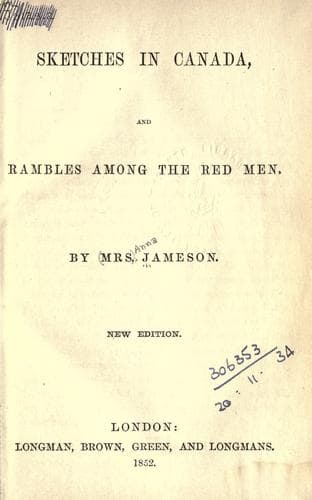
Sketches in Canada, and rambles among the red menJameson, Mrs. (Anna)
History
Sketches in Canada, and rambles among the red men
Jameson, Mrs. (Anna)
Indians of North America -- Canada; Ontario -- Description and travel
The origin of the city was a little palisadoed fort, erected here, in
1702, by the French under La Motte Cadillac, to defend their fur trade.
It was then called Fort Portchartrain. From this time till 1760 it
remained in possession of the French, and continued to increase slowly.
So late as 1721, Charlevoix speaks of the vast herds of buffaloes
ranging the plains west of the city. Meantime, under the protection of
the fort, the settlement and cultivation of the neighbouring districts
went on, in spite of the attacks of some of the neighbouring tribes of
Indians, particularly the Ottagamies, who, with the Iroquois, seem to
have been the only decided and irreconcilable enemies whom the French
found in this province. The capture of Quebec, and the death of Wolfe,
being followed by the cession of the whole of the French territory in
North America to the power of Great Britain, Detroit, with all the other
trading posts in the west, was given up to the English. It is curious
that the French submitted to this change of masters more easily than the
Indians, who were by no means inclined to exchange the French for the
English alliance. "Whatever may have been the cause," says Governor
Cass, "the fact is certain, that there is in the French character a
peculiar adaptation to the habits and feelings of the Indians; and to
this day the period of French domination is the era of all that is happy
in Indian reminiscences."
The conciliating manners of the French towards the Indians, and the
judgment with which they managed all their intercourse with them, has
had a permanent effect on the minds of those tribes who were in
friendship with them. At this day, if the British are generally
preferred to the Americans, the French are always preferred to either. A
Chippewa chief, addressing the American agent at the Sault S^{te.}
Marie, so late as 1826, thus fondly referred to the period of the French
dominion:--"When the Frenchmen arrived at these Falls, they came and
kissed us. They called us children; and we found them fathers. We lived
like brethren in the same lodge; and we had always wherewithal to clothe
us. They never mocked at our ceremonies, and they never molested the
places of our dead. Seven generations of men have passed away, but we
have not forgotten it. Just, very just, were they towards us!"[19]
The discontent of the Indian tribes upon the transfer of the forts and
trading posts into the possession of the British, showed itself early,
and at length gave rise to one of the most prolonged and savage of all
the Indian wars, that of Pontiac, in 1763.
[Footnote 19: Vide Historical Sketches of Michigan.]
PONTIAC.
Public-domain text, read in full here on John Shaqi.
Reviews
Reviews
No reviews yet
Be the first to share your thoughts on this work.
Elsewhere in the archive
Join the Discussion
Join the discussion
Sign in to leave a comment or review.
Sign InorCreate an account