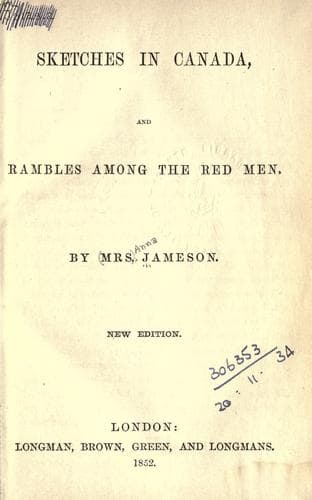
Sketches in Canada, and rambles among the red menJameson, Mrs. (Anna)
History
Sketches in Canada, and rambles among the red men
Jameson, Mrs. (Anna)
Indians of North America -- Canada; Ontario -- Description and travel
As they have called Tecumseh the Indian Napoleon, they might style
Pontiac the Indian Alexander--I do not mean him of Russia, but the
Greek. Here, for instance, is a touch of magnanimity quite in the
_Alexander-the-great_ style. Pontiac, before the commencement of the
war, had provided for the safety of a British officer, Major Rogers by
name, who was afterwards employed to relieve Detroit, when besieged by
the Indians. On this occasion he sent Pontiac a present of a bottle of
brandy, to show he had not forgotten his former obligations to him.
Those who were around the Indian warrior when the present arrived,
particularly some Frenchmen, warned him not to taste it, as it might be
poisoned. Pontiac instantly took a draught from it, saying, as he put
the bottle to his lips, that "it was not _in the power_ of Major Rogers
to hurt him who had so lately saved his life." I think this story is no
unworthy pendant to that of Alexander and his physician.
But what avails it all! who knows or cares about Pontiac and his
Ottawas?
"Vain was the chief's, the warrior's pride!
He had no poet--and he died!"
If I dwell on these horrid and obscure conflicts, it is partly to amuse
the languid idle hours of convalescence, partly to inspire you with some
interest for the localities around me:--and I may as well, while the pen
is in my hand, give you the conclusion of the story.
Pontiac carried on the war with so much talent, courage, and resources,
that the British government found it necessary to send a considerable
force against him. General Bradstreet came up here with three thousand
men, wasting the lands of the Miami and Wyandot Indians, "burning their
villages, and destroying their corn-fields;" and I pray you to observe
that in all the accounts of our expeditions against the Indians, as well
as those of the Americans under General Wayne and General Harrison,
mention is made of the destruction of corn-fields (plantations of Indian
corn) to a great extent, which show that _some_ attention must have been
paid to agriculture, even by these wild hunting tribes. I find mention
also of a very interesting and beautiful tradition connected with these
regions. To the east of the Detroit territory, there was settled from
ancient times a band of Wyandots or Hurons, who were called the neutral
nation; they never took part in the wars and conflicts of the other
tribes. They had two principal villages, which were like the cities of
refuge among the Israelites; whoever fled there from an enemy found a
secure and inviolable sanctuary. If two enemies from tribes long at
deadly variance met there, they were friends while standing on that
consecrated ground. To what circumstances this extraordinary institution
owed its existence is not known. It was destroyed after the arrival of
the French in the country--not by them, but by some national and
internal feud.
Public-domain text, read in full here on John Shaqi.
Reviews
Reviews
No reviews yet
Be the first to share your thoughts on this work.
Elsewhere in the archive
Join the Discussion
Join the discussion
Sign in to leave a comment or review.
Sign InorCreate an account