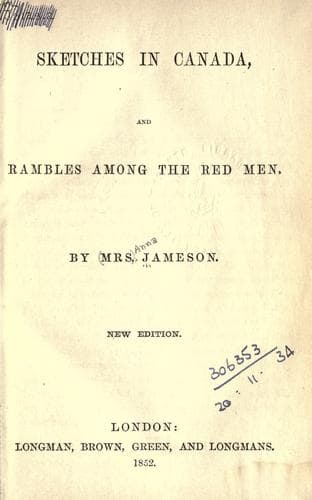
Sketches in Canada, and rambles among the red menJameson, Mrs. (Anna)
History
Sketches in Canada, and rambles among the red men
Jameson, Mrs. (Anna)
Indians of North America -- Canada; Ontario -- Description and travel
But to return to Pontiac. With all his talents, he could not maintain a
standing or permanent army, such a thing being contrary to all the
Indian usages, and quite incompatible with their mode of life. His
warriors fell away from him every season, and departed to their hunting
grounds to provide food for their families. The British pressed forward,
took possession of their whole country, and the tribes were obliged to
beg for peace. Pontiac disdained to take any part in these negotiations,
and retired to the Illinois, where he was murdered, from some motive of
private animosity, by a Peoria Indian. The Ottawas, Chippewas, and
Pottowottomies, who had been allied under his command, thought it
incumbent on them to avenge his death, and nearly exterminated the whole
nation of the Peorias--and this was the life and the fall of Pontiac.
The name of this great chief is commemorated in that of a flourishing
village, or rising town, about twenty miles west of Detroit, which is
called _Pontiac_, as one of the townships in Upper Canada is styled
_Tecumseh_: thus literally illustrating those beautiful lines in Mrs.
Sigourney's poem on Indian names:--
"Their memory liveth on your hills,
_Their baptism on your shore_;
Your everlasting rivers speak
Their dialect of yore!"
For rivers, bearing their old Indian names, we have here the Miami, the
Huron, the Sandusky: but most of the points of land, rivers, islands,
&c., bear the French appellations, as Point Pelée, River au Glaize,
River des Canards, Gros-Isle, &c.
The _mélange_ of proper names in this immediate neighbourhood is
sufficiently curious. Here we have Pontiac, Romeo, Ypsilanti, and Byron,
all within no great distance of each other.
* * * * *
Long after the time of Pontiac, Detroit and all the country round it
became the scene of even more horrid and unnatural conflicts between the
Americans and British, during the war of the revolution, in which the
Indians were engaged against the Americans. When peace was proclaimed,
and the independence of the United States recognised by Great Britain,
this savage war on the frontiers still continued, and mutual aggressions
and injuries have left bitter feelings rankling on both sides. Let us
hope that in another generation they may be effaced. For myself, I
cannot contemplate the possibility of another war between the English
and Americans without a mingled disgust and terror, as something cruel,
unnatural, fratricidal. Have we not the same ancestry, the same
father-land, the same language? "Though to drain our blood from out
their being were an aim," they cannot do it! The ruffian refuse of the
two nations--the most ignorant, common-minded, and vulgar among them,
may hate each other, and give each other nicknames--but every year
diminishes the number of such; and while the two governments are shaking
hands across the Atlantic, it were indeed supremely ridiculous if they
were to go to cuffs across the Detroit and Niagara!
Public-domain text, read in full here on John Shaqi.
Reviews
Reviews
No reviews yet
Be the first to share your thoughts on this work.
Elsewhere in the archive
Join the Discussion
Join the discussion
Sign in to leave a comment or review.
Sign InorCreate an account