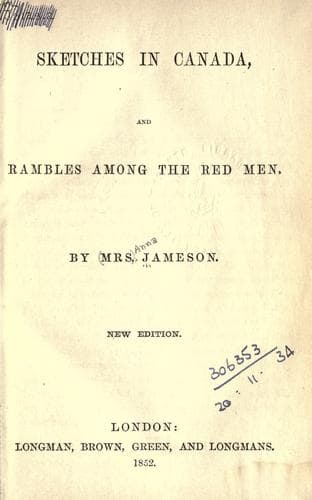
Sketches in Canada, and rambles among the red menJameson, Mrs. (Anna)
History
Sketches in Canada, and rambles among the red men
Jameson, Mrs. (Anna)
Indians of North America -- Canada; Ontario -- Description and travel
I should doubt, from all I see and hear, that the Indian squaw is that
absolute slave, drudge, and nonentity in the community, which she has
been described. She is despotic in her lodge, and every thing it
contains is hers; even of the game her husband kills, she has the
uncontrolled disposal. If her husband does not please her, she scolds
and even cuffs him; and it is in the highest degree unmanly to answer or
strike her. I have seen here a woman scolding and quarrelling with her
husband, seize him by the hair, in a style that might have become
civilised Billingsgate, or christian St. Giles's, and the next day I
have beheld the same couple sit lovingly together on the sunny side of
the wigwam, she kneeling behind him, and combing and arranging the hair
she had been pulling from his head the day before; just such a group as
I remember to have seen about Naples, or the Campagna di Roma, with very
little obvious difference either in costume or complexion.
There is no law against marrying near relations, but it is always
avoided; it is contrary to their customs: even first cousins do not
marry. The tie of blood seems considered as stronger than that of
marriage. A woman considers that she belongs more to her own relatives
than to her husband or his relatives; yet, notwithstanding this and the
facility of divorce, separations between husband and wife are very rare.
A couple will go on "squabbling and making it up" all their lives,
without having recourse to this expedient. If from displeasure, satiety,
or any other cause, a man sends his wife away, she goes back to her
relations, and invariably takes her children with her. The indefeasible
right of the mother to her offspring is Indian law, or rather, the
contrary notion does not seem to have entered their minds. A widow
remains subject to her husband's relations for two years after his
death; this is the decent period of mourning. At the end of two years,
she returns some of the presents made to her by her late husband, goes
back to her own relatives, and may marry again.
These particulars, and others which may follow, apply to the Chippewas
and the Ottawas around me; other tribes have other customs. I speak
merely of those things which are brought under my own immediate
observation and attention.
INDIAN AMAZON.
Public-domain text, read in full here on John Shaqi.
Reviews
Reviews
No reviews yet
Be the first to share your thoughts on this work.
Elsewhere in the archive
Join the Discussion
Join the discussion
Sign in to leave a comment or review.
Sign InorCreate an account