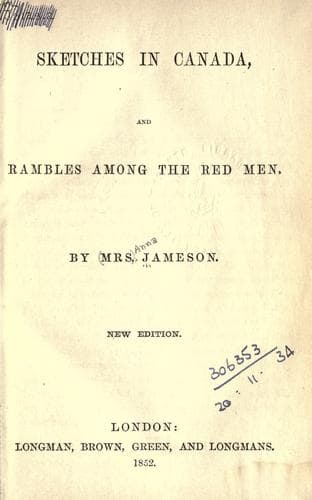
Sketches in Canada, and rambles among the red menJameson, Mrs. (Anna)
History
Sketches in Canada, and rambles among the red men
Jameson, Mrs. (Anna)
Indians of North America -- Canada; Ontario -- Description and travel
During the last American war of 1813, the young widow of a chief who had
been killed in battle, assumed his arms, ornaments, wampum, medal, and
went out with several war parties, in which she distinguished herself by
her exploits. Mrs. Schoolcraft, when a girl of eleven or twelve years
old, saw this woman, who was brought into the Fort at Mackinaw and
introduced to the commanding officer; and retains a lively recollection
of her appearance, and the interest and curiosity she excited. She was
rather below the middle size, slight and delicate in figure, like most
of the squaws;--covered with rich ornaments, silver armlets, with the
scalping-knife, pouch, medals, tomahawk--all the insignia, in short, of
an Indian warrior, except the war-paint and feathers. In the room hung a
large mirror, in which she surveyed herself with evident admiration and
delight, turning round and round before it, and laughing triumphantly.
She was invited to dine at the officers' mess, perhaps as a joke, but
conducted herself with so much intuitive propriety and decorum, that she
was dismissed with all honour and respect, and with handsome presents. I
could not learn what became of her afterwards.
Heroic women are not rare among the Indians, women who can bravely
suffer--bravely die; but Amazonian women, female amateur warriors, are
very extraordinary; I never heard but of this one instance. Generally,
the squaws around me give me the impression of exceeding feminine
delicacy and modesty, and of the most submissive gentleness. Female
chiefs, however, are not unknown in Indian history. There was a famous
_Squaw Sachem_, or chief, in the time of the early settlers. The present
head chief of the Ottawas, a very fine old man, succeeded a female, who,
it is further said, abdicated in his favour.
Even the standing rule or custom that women are never admitted to
councils has been evaded. At the treaty of Butte des Morts, in 1827, an
old Chippewa woman, the wife of a superannuated chief, appeared in place
of her husband, wearing his medal, and to all intents and purposes
representing him. The American commissioners treated her with studied
respect and distinction, and made her rich presents in cloth, ornaments,
tobacco, &c. On her return to her own village, she was waylaid and
murdered by a party of Menomonies. The next year two Menomonie women
were taken and put to death by the Chippewas: such is the Indian law of
retaliation.
* * * * *
CHIPPEWA LANGUAGE.
Public-domain text, read in full here on John Shaqi.
Reviews
Reviews
No reviews yet
Be the first to share your thoughts on this work.
Elsewhere in the archive
Join the Discussion
Join the discussion
Sign in to leave a comment or review.
Sign InorCreate an account