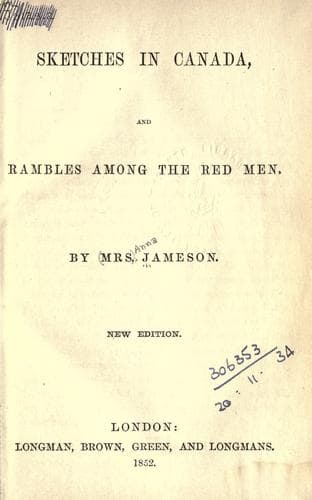
Sketches in Canada, and rambles among the red menJameson, Mrs. (Anna)
History
Sketches in Canada, and rambles among the red men
Jameson, Mrs. (Anna)
Indians of North America -- Canada; Ontario -- Description and travel
There are certain words and expressions which are in a manner masculine
and feminine by some prescriptive right, and cannot be used
indifferently by the two sexes. Thus, one man addressing another says
"nichi," or "neejee," my friend. One woman addressing another woman
says, "Nin,dong,quay" (as nearly as I can imitate the sound), my friend,
or rather, I believe, female relation; and it would be indelicacy in one
sex, and arrogance in the other, to exchange these terms between man and
woman. When a woman is surprised at anything she sees or hears, she
exclaims, "N'ya!" When a man is surprised he exclaims, "T'ya!" and it
would be contrary to all Indian notions of propriety and decorum, if a
man condescended to say "N'ya!" or if a woman presumed to use the
masculine interjection "T'ya!" I could give you other curious instances
of the same kind. They have different words for eldest brother, eldest
sister, and for brother and sister in general. _Brother_ is a common
expression of kindness, _father_, of respect, and grandfather is a title
of very great respect.
They have no form of imprecation or swearing. Closing the hand, then
throwing it forth and opening it suddenly with a jerk, is the strongest
gesture of contempt, and the words "bad dog," the strongest expression
of abuse and vituperation: both are unpardonable insults, and used
sparingly.
A mother's term of endearment to her child is "My bird--my young one,"
and sometimes playfully "My old man." When I asked what words were used
of reproach or menace, I was told that Indian children were _never_
scolded--_never_ menaced.
The form of salutation in common use between the Indians and the whites
is the _bo-jou_, borrowed from the early French settlers, the first
Europeans with whom the North-west Indians were brought in contact.
Among themselves there is no set form of salutation; when two friends
meet after a long absence, they take hands, and exclaim, "We see each
other!"
* * * * *
STORY-TELLERS.
I have been "working like beaver," to borrow an Indian phrase. This has
been a rich and busy day. What with listening, learning, scribbling,
transcribing, my wits as well as my pen are well nigh worn to a stump.
But I am not going to tell here of well-known Indian customs, and repeat
anecdotes to be found in all the popular books of travel. With the
general characteristics of Indian life and manners I suppose the reader
already familiar, from the works of Cooper, Washington Irving, Charles
Hoffman, and others. I can add nothing to these sources of information;
only bear testimony to the vigour, and liveliness and truth of the
pictures they have drawn. I am amused at every moment by the coincidence
between what I see and what I have read; but I must confess I never read
anything like the Indian fictions I have just been transcribing from the
first and highest authority.
Public-domain text, read in full here on John Shaqi.
Reviews
Reviews
No reviews yet
Be the first to share your thoughts on this work.
Elsewhere in the archive
Join the Discussion
Join the discussion
Sign in to leave a comment or review.
Sign InorCreate an account