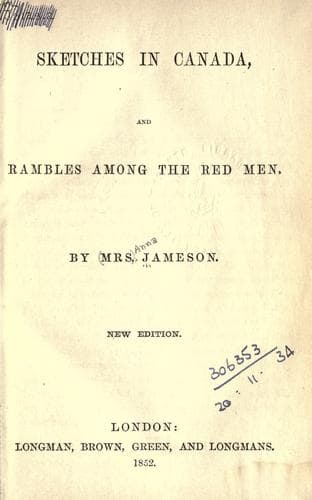
Sketches in Canada, and rambles among the red menJameson, Mrs. (Anna)
History
Sketches in Canada, and rambles among the red men
Jameson, Mrs. (Anna)
Indians of North America -- Canada; Ontario -- Description and travel
The language spoken around me is the Chippewa tongue, which, with little
variation, is spoken also by the Ottawas, Pottowottomies and
Missasaguas, and diffused all over the country of the lakes, and through
a population of about seventy thousand. It is in these countries what
the French is in Europe, the language of trade and diplomacy, understood
and spoken by those tribes, with whom it is not vernacular. In this
language Mrs. Schoolcraft generally speaks to her children and Indian
domestics. It is not only very sweet and musical to the ear, with its
soft inflections and lengthened vowels, but very complex and artificial
in its construction, and subject to strict grammatical rules; this, for
an unwritten language--for they have no alphabet--appears to me very
curious. The particulars which follow I have from Mr. Schoolcraft, who
has deeply studied the Chippewa language, and what he terms, not without
reason, the philosophy of its syntax.
The great division of all words, and the pervading principle of the
language, is the distinction into animate and inanimate objects: not
only nouns, but adjectives, verbs, pronouns, are inflected in accordance
with this principle. The distinction, however, seems as arbitrary as
that between masculine and feminine nouns in some European languages.
Trees, for instance, are of the animate gender. The sun, moon, thunder
and lightning, a canoe, a pipe, a water-fall, are all animate. The verb
is not only modified to agree with the subject, it must be farther
modified to agree with the object spoken of, whether animate or
inanimate: an Indian cannot say simply, I love, I eat; the word must
express by its inflection what he loves or eats, whether it belong to
the animate or inanimate gender.
What is curious enough is, that the noun or name can be conjugated like
a verb: the word _man_, for instance, can be inflected to express, I
_am_ a man, thou _art_ a man, he _is_ a man, I _was_ a man, I _will be_
a man, and so forth; and the word husband can be so inflected as to
signify by a change of syllables, _I have a_ husband, and _I have not_ a
husband.
They have three numbers, like the Greek, but of different signification:
they have the singular, and two plurals, one indefinite and general like
ours, and one including the persons or things present, and excluding
those which are absent; and distinct inflections are required for these
two plurals.
There are distinct words to express certain distinctions of sex, as with
us; for instance, man, woman, father, mother, sister, brother, are
distinct words, but more commonly sex is distinguished by a masculine or
feminine syllable or termination. The word _equay_, a woman, is thus
used as a feminine termination where persons are concerned. Ogima, is a
chief, and Ogimquay, a female chief.
Public-domain text, read in full here on John Shaqi.
Reviews
Reviews
No reviews yet
Be the first to share your thoughts on this work.
Elsewhere in the archive
Join the Discussion
Join the discussion
Sign in to leave a comment or review.
Sign InorCreate an account