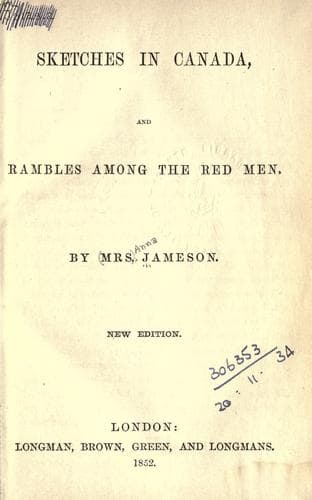
Sketches in Canada, and rambles among the red menJameson, Mrs. (Anna)
History
Sketches in Canada, and rambles among the red men
Jameson, Mrs. (Anna)
Indians of North America -- Canada; Ontario -- Description and travel
The Chippewas, as you perhaps know, have long been reckoned among the
most warlike and numerous, but also among the wildest and more
untameable nations of the north-west. In progressing with the other
Algonquin tribes from south to north, they seem to have crossed the St.
Lawrence and dispersed themselves along the shores of Lake Ontario, and
Lake Huron and its islands. Driven westward before the Iroquois, as
_they_ retired before the French and Hurons, the Chippewas appear to
have crossed the St. Mary's River, and then spread along the south
shores of Lake Superior. Their council fire, and the chief seat of the
nation, was upon a promontory at the farthest end of Lake Superior,
called by the French La Pointe, and by the Indians Che,goi,me,gon: by
one name or the other you will find it on most maps, as it has long been
a place of importance in the fur trade. Here was the grand national
council fire (the extinction of which foretold, if it did not occasion,
some dread national calamity), and the residence of the presiding chief.
The Indians know neither sovereignty nor nobility, but when one family
has produced several distinguished war-chiefs, the dignity becomes by
courtesy or custom hereditary; and from whatever reason, the family of
Wayish,ki or the Mudgi,kiwis, exercised, even from a remote period, a
sort of influence over the rest of the tribe. One traveller says that
the present descendants of these chiefs evince such a pride of ancestry
as could only be looked for in feudal or despotic monarchies. The
present representative, Piz,hi,kee (the Buffalo), my illustrious cousin,
still resides at La Pointe. When presented with a silver medal of
authority from the American government, he said haughtily, "What need of
this? it is known to all whence I am descended!" Family pride, you see,
lies somewhere very deep in human nature.
When the Chippewas first penetrated to these regions, they came in
contact with the Ottagamies or Foxes, who, being descended from the same
stock, received them as brothers, and at first ceded to them a part of
their boundless hunting-grounds; and as these Ottagamies were friends
and allies of the Sioux, these three nations continued for some time
friends, and inter-marriages and family alliances took place. But the
increasing power of the Chippewas soon excited the jealousy and
apprehension of the other two tribes. The Ottagamies committed inroads
on their hunting-grounds (this is the primary cause of almost all the
Indian wars), the Chippewas sent an embassy to complain of the injury,
and desired the Ottagamies to restrain their young men within the
stipulated bounds. The latter returned an insulting answer. The
war-hatchet was raised, and the Sioux and the Ottagamies united against
the Chippewas: this was about 1726 or 1730. From this time there has
been no peace between the Chippewas and Sioux.
[Footnote 42: _Ant._ I know you now, Sir, a gentleman born.
Public-domain text, read in full here on John Shaqi.
Reviews
Reviews
No reviews yet
Be the first to share your thoughts on this work.
Elsewhere in the archive
Join the Discussion
Join the discussion
Sign in to leave a comment or review.
Sign InorCreate an account