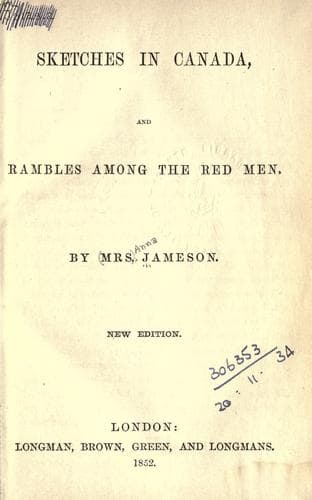
Sketches in Canada, and rambles among the red menJameson, Mrs. (Anna)
History
Sketches in Canada, and rambles among the red men
Jameson, Mrs. (Anna)
Indians of North America -- Canada; Ontario -- Description and travel
_Clo._ Aye, that I have been any time these four hours.--_Winter's
Tale._]
[Footnote 43: The name is thus pronounced, but I have seen it spelt
Wabbajik.]
WAUB-OJEEG.
It happened just before the declaration of war, that a young Chippewa
girl was married to a Sioux chief of great distinction, and bore him two
sons. When hostilities commenced the Sioux chief retired to his own
tribe, and his wife remained with her relations, according to Indian
custom. The two children, belonging to both tribes, were hardly safe
with either; but as the father was best able to protect them, it was at
last decided that they should accompany him. The Sioux chief and his
boys departed to join his warriors, accompanied by his Chippewa wife and
her relations, till they were in safety: then the young wife returned
home weeping and inconsolable for the loss of her husband and children.
Some years afterwards she consented to become the wife of the great
chief at Chegoimegon. Her son by this marriage was Mamongazida, or
Mongazida (the Loon's-foot), a chief of great celebrity, who led a
strong party of his nation in the Canadian wars between the French and
English, fighting on the side of the French. He was present at the
battle of Quebec, when Wolfe was killed, and according to the Indian
tradition, the Marquis Montcalm died in Mongazida's arms. After the war
was over, he "shook hands" with the English. He was at the grand
assemblage of chiefs, convened by Sir William Johnstone, at Niagara, and
from him received a rich gorget, and broad belt of wampum, as pledges of
peace and alliance with the English. These relics were preserved in the
family with great veneration, and inherited by Waub-Ojeeg, and
afterwards by his younger brother, Camudwa; but it happened that when
Camudwa was out on a winter-hunt near the river Broulé, he and all his
family were overtaken by famine and starved to death, and these insignia
were then lost and never recovered. This last incident is a specimen of
the common vicissitudes of Indian life; and when listening to their
domestic histories, I observe that the events of paramount interest are
the want or the abundance of food--hunger or plenty. "We killed a moose,
or a bear, and had meat for so many days:" or, "we followed on the track
of a bear, and he escaped us; we had _no_ meat for so many days." These
are the ever-recurring topics which in their conversation stand instead
of the last brilliant essay in the Edinburgh or Quarterly, or the last
news from Russia or Spain. Starvation from famine is not uncommon; and I
am afraid, from all I hear, that cannibalism under such circumstances is
not unknown. Remembering some recent instances nearer home, when extreme
hunger produced the same horrid result, I could not be much astonished.
Public-domain text, read in full here on John Shaqi.
Reviews
Reviews
No reviews yet
Be the first to share your thoughts on this work.
Elsewhere in the archive
Join the Discussion
Join the discussion
Sign in to leave a comment or review.
Sign InorCreate an account