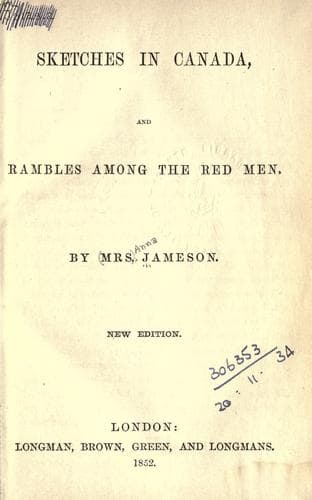
Sketches in Canada, and rambles among the red menJameson, Mrs. (Anna)
History
Sketches in Canada, and rambles among the red men
Jameson, Mrs. (Anna)
Indians of North America -- Canada; Ontario -- Description and travel
To return. Waub-Ojeeg was the second son of this famous Mongazida. Once
when the latter went out on his "fall hunts," on the grounds near the
Sioux territory, taking all his relatives with him (upwards of twenty in
number), they were attacked by the Sioux at early dawn, in the usual
manner. The first volley had gone through the lodges; before the second
could be fired, Mongazida rushed out, and proclaiming his own name with
a loud voice, demanded if Wabash, his mother's son, were among the
assailants. There was a pause, and then a tall figure in his war-dress,
and a profusion of feathers in his head, stepped forward and gave his
hand to his half-brother. They all repaired to the lodge in peace
together; but at the moment the Sioux chief stooped to enter,
Waub-Ojeeg, then a boy of eight years old, who had planted himself at
the entrance to defend it, struck him a blow on the forehead with his
little war-club. Wabash, enchanted, took him up in his arms and
prophesied that he would become a great war chief, and an implacable
enemy of the Sioux. Subsequently the prophecy was accomplished, and
Waub-Ojeeg commanded his nation in all the war-parties against the Sioux
and Ottagamies. He was generally victorious, and so entirely defeated
the Ottagamies, that they never afterwards ventured to oppose him, but
retired down the Wisconsin river, where they are now settled.
But Waub-Ojeeg was something more and better than merely a successful
warrior: he was remarkable for his eloquence, and composed a number of
war-songs, which were sung through the Chippewa villages, and some of
which his daughter can repeat. He was no less skilful in hunting than in
war. His hunting-grounds extended to the river Broulé, at Fon du Lac;
and he killed any one who dared to intrude on his district. The skins he
took annually were worth three hundred and fifty dollars, a sum amply
sufficient to make him rich in clothing, arms, powder, vermilion, and
trinkets. Like Tecumseh, he would not marry early lest it should turn
his attention from war, but at the age of thirty he married a widow, by
whom he had two sons. Becoming tired of this elderly helpmate, he took a
young wife, a beautiful girl of fourteen, by whom he had six children;
of these my Neengai is the eldest. She described her father as
affectionate and domestic. "There was always plenty of bear's meat and
deer's flesh in the lodge." He had a splendid lodge, sixty feet in
length, which he was fond of ornamenting. In the centre there was a
strong post, which rose several feet above the roof, and on the top
there was the carved figure of an owl, which veered with the wind. This
owl seems to have answered the same purpose as the flag on the tower of
Windsor Castle: it was the insignia of his power and of his presence.
When absent on his long winter hunts the lodge was shut up, and the owl
taken down.
Public-domain text, read in full here on John Shaqi.
Reviews
Reviews
No reviews yet
Be the first to share your thoughts on this work.
Elsewhere in the archive
Join the Discussion
Join the discussion
Sign in to leave a comment or review.
Sign InorCreate an account