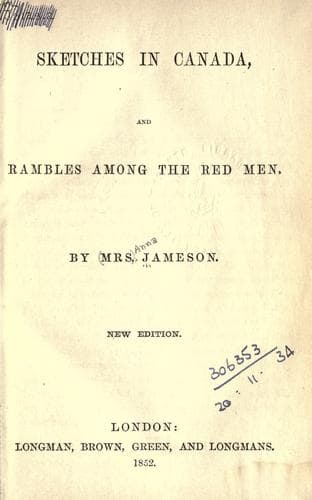
Sketches in Canada, and rambles among the red menJameson, Mrs. (Anna)
History
Sketches in Canada, and rambles among the red men
Jameson, Mrs. (Anna)
Indians of North America -- Canada; Ontario -- Description and travel
Take into consideration, in the first place, that in these Indian
communities the task of providing subsistence falls solely and entirely
on the men. When it is said, in general terms, that the men do nothing
but _hunt_ all day, while the women are engaged in perpetual _toil_, I
suppose this suggests to civilised readers the idea of a party of
gentlemen at Melton, or a turn-out of Mr. Meynell's hounds; or at most a
deer-stalking excursion to the Highlands--a holiday affair; while the
women, poor souls! must sit at home and sew, and spin, and cook
victuals. But what is really the life of an Indian hunter?--one of
incessant, almost killing toil, and often danger.[50] A hunter goes out
at dawn, knowing that, if he returns empty, his wife and his little ones
must _starve_--no uncommon predicament! He comes home at sunset, spent
with fatigue, and unable even to speak. His wife takes off his
moccasins, places before him what food she has, or, if latterly the
chase has failed, probably no food at all, or only a little parched wild
rice. She then examines his hunting-pouch, and in it finds the claws,
or beak, or tongue of the game, or other indications by which she knows
what it is, and where to find it. She then goes for it, and drags it
home. When he is refreshed, the hunter caresses his wife and children,
relates the events of his chase, smokes his pipe, and goes to sleep--to
begin the same life on the following day.
Where, then, the whole duty and labour of providing the means of
subsistence, ennobled by danger and courage, fall upon the man, the
woman naturally sinks in importance, and is a dependent drudge. But she
is not therefore, I suppose, so _very_ miserable, nor, relatively, so
very abject; she is sure of protection; sure of maintenance, at least
while the man has it; sure of kind treatment; sure that she will never
have her children taken from her but by death; sees none better off than
herself, and has no conception of a superior destiny; and it is evident
that in such a state the appointed and necessary share of the woman is
the household work, and all other domestic labour. As to the necessity
of carrying burthens, when moving the camp from place to place, and
felling and carrying wood, this is the most dreadful part of her lot;
and however accustomed from youth to the axe, the paddle, and the
carrying-belt, it brings on internal injuries and severe suffering--and
yet it _must_ be done. For a man to carry burthens would absolutely
incapacitate him for a hunter, and consequently from procuring
sufficient meat for his family. Hence, perhaps, the contempt with which
they regard it. And an Indian woman is unhappy, and her pride is hurt,
if her husband should be seen with a load on his back; this was strongly
expressed by one among them who said it was "unmanly;" and that "she
could not bear to see it!"
Public-domain text, read in full here on John Shaqi.
Reviews
Reviews
No reviews yet
Be the first to share your thoughts on this work.
Elsewhere in the archive
Join the Discussion
Join the discussion
Sign in to leave a comment or review.
Sign InorCreate an account