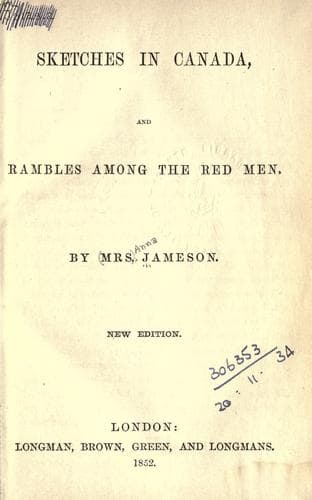
Sketches in Canada, and rambles among the red menJameson, Mrs. (Anna)
History
Sketches in Canada, and rambles among the red men
Jameson, Mrs. (Anna)
Indians of North America -- Canada; Ontario -- Description and travel
Hence, however hard the lot of the woman, she is in no _false_ position.
The two sexes are in their natural and true position relatively to the
state of society, and the means of subsistence.
The first step from the hunting to the agricultural state is the first
step in the emancipation of the female. I know there are some writers
who lament that the introduction of agriculture has not benefited the
Indian women, but rather added to their toils, as a great proportion of
the hoeing and planting has devolved on them; but among the Ottawas,
where this is the case, the women are decidedly in a better state than
among the hunting Chippewas; they can sell or dispose of the produce
raised by themselves, if there be more than is necessary for the family,
and they take some share in the bargains and business of the tribe: and
add, that among all these tribes, in the division of the money payments
for the ceded land, every woman receives her individual share.
Lewis and Clarke, in exploring the Missouri, came upon a tribe of
Indians who, from local circumstances, kill little game, and live
principally on fish and roots; and as the women are equally expert with
the men in procuring subsistence, they have a rank and influence very
rarely found among Indians. The females are permitted to speak freely
before the men, to whom indeed they sometimes address themselves in a
tone of authority. On many subjects their judgment and opinion are
respected, and in matters of trade their advice is generally asked and
pursued; the labours of the family too are shared equally.[51] This
seems to be a case in point.
Then, when we speak of the _drudgery_ of the women, we must note the
equal division of labour; there is no class of women privileged to sit
still while others work. Every squaw makes the clothing, mats,
moccasins, and boils the kettle for her own family. Compare her life
with the refined leisure of an elegant woman in the higher classes of
our society, and it is wretched and abject; but compare her life with
that of a servant-maid of all work, or a factory-girl,--I do say that
the condition of the squaw is gracious in comparison, dignified by
domestic feelings, and by equality with all around her. If women are to
be exempted from toil in reverence to the sex, and as _women_, I can
understand this, though I think it unreasonable; but if it be merely a
privilege of station, and confined to a certain set, while the great
primeval penalty is doubled on the rest, then I do not see where is the
great gallantry and consistency of this our Christendom, nor what right
we have to look down upon the barbarism of the Indian savages who make
_drudges_ of their women.
Public-domain text, read in full here on John Shaqi.
Reviews
Reviews
No reviews yet
Be the first to share your thoughts on this work.
Elsewhere in the archive
Join the Discussion
Join the discussion
Sign in to leave a comment or review.
Sign InorCreate an account