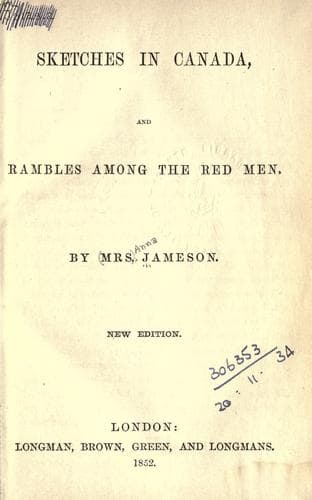
Sketches in Canada, and rambles among the red menJameson, Mrs. (Anna)
History
Sketches in Canada, and rambles among the red men
Jameson, Mrs. (Anna)
Indians of North America -- Canada; Ontario -- Description and travel
Yes; the "kind of anticipation" through which Joanna Baillie conceived
and wrote her noble tragedies. Where did she, whose life was pure and
"retired as noontide dew," find the dark, stern, terrible elements, out
of which she framed the delineations of character and passion in De
Montfort, Ethwald, Basil, Constantine?--where but in her own prophetic
heart and genius?--in that intuitive, almost unconscious revelation of
the universal nature, which makes the poet, and not experience or
knowledge. Joanna Baillie, whose most tender and refined, and womanly
and christian spirit never, I believe, admitted an ungentle thought of
any living being, created De Montfort, and gave us the physiology of
Hatred; and might well, like Goethe, stand astonished at the truth of
her own delineation.
* * * * *
LITERARY WOMEN.
Rehbein once observed to Goethe "that the women who had distinguished
themselves in literature, poetry especially, were almost universally
women who had been disappointed in their best affections, and sought in
this direction of the intellect a sort of compensation. When women are
married, and have children to take care of, they do not often think of
writing poetry."
This is not very politely or delicately expressed; but we must not
therefore shrink from it, for it involves some important considerations.
It is most certain that among the women who have been distinguished in
literature, three-fourths have been either by nature, or fate, or the
law of society, placed in a painful or a false position; it is also most
certain that in these days when society is becoming every day more
artificial and more complex, and marriage, as the gentlemen assure us,
more and more expensive, hazardous, and inexpedient, women _must_ find
means to fill up the void of existence. Men, our natural protectors, our
lawgivers, our masters, throw us upon our own resources; the qualities
which they pretend to admire in us,--the overflowing, the clinging
affections of a warm heart--the household devotion,--the submissive wish
to please, that feels "every vanity in fondness lost,"--the tender
shrinking sensitiveness which Adam thought so charming in his Eve,--to
cultivate these, to make them, by artificial means, the staple of the
womanly character, is it not to cultivate a taste for sunshine and
roses, in those we send to pass their lives in the arctic zone? We have
gone away from nature, and we must--if we can--substitute another
nature. Art, literature, and science remain to us. Religion, which
formerly opened the doors of nunneries and convents to forlorn women,
now mingling her beautiful and soothing influence with resources which
the prejudices of the world have yet left open to us, teaches us another
lesson, that only in utility, such as is left to us,--only in the
assiduous employment of such faculties as we are permitted to exercise,
can we find health and peace, and compensation for the wasted or
Public-domain text, read in full here on John Shaqi.
Reviews
Reviews
No reviews yet
Be the first to share your thoughts on this work.
Join the Discussion
Join the discussion
Sign in to leave a comment or review.
Sign InorCreate an account