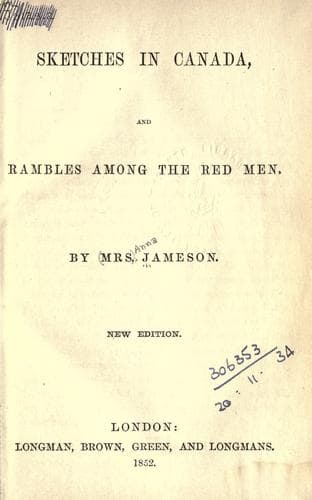
Sketches in Canada, and rambles among the red menJameson, Mrs. (Anna)
History
Sketches in Canada, and rambles among the red men
Jameson, Mrs. (Anna)
Indians of North America -- Canada; Ontario -- Description and travel
How far are our perceptions confined to our outward senses? Can any one
tell?--for that our perceptions are not wholly confined to impressions
taken in by the outward senses, seems the only one thing proved; and
are such sensible impressions the only real ones? When any one asks me
gaily the so common and common-place question--common even in these our
rational times--"Do you now really believe in ghosts?" I generally
answer as gaily--"I really don't know!" In the common, vulgar meaning of
the words, I certainly do _not_; but in the reality of many things
termed imaginary I certainly do.
* * * * *
The following beautiful and original interpretation of Goethe's ballad
of the "Erl-King" is not in Ekermann's book (the "Gespräche mit Goethe,"
which I am now studying), but I give it to you in the words in which it
was given to me.
"Goethe's 'Erl-König' is a moral allegory of deep meaning, though I am
not sure he meant it as such, or intended all that it signifies. There
are beings in the world who see, who feel, with a finer sense than that
granted to other mortals. They see the spiritual, the imaginative
sorrow, or danger, or terror which threatens them; and those who see not
with the same eyes, talk reason and philosophy to them. The poor
frightened child cries out for aid, for mercy; and Papa Wisdom--worldly
wisdom--answers,--
"'Mein Sohn, es ist ein Nebelstrief!'
"Or,--
"'Es scheinen die alten Weiden so grau!'
"It is only the vapour-wreath, or the grey willows waving, and tells him
to be quiet! At last the poor child of feeling is found dead in the arms
of Wisdom, from causes which no one else perceived--or believed! Is it
not often so?"
* * * * *
On the subject of religion I find this beautiful comparison, but am not
sure whether it be Ekermann's or Goethe's. "A connoisseur standing
before the picture of a great master will regard it as a whole. He knows
how to combine instantly the scattered parts into the general effect;
the universal, as well as the individual, is to him animated. He has no
preference for certain portions: he does not ask why this or that face
is beautiful or otherwise; why _this_ part is light, _that_ dark; only
he requires that all shall be in the right place, and according to the
just rules of art; but place an ignorant person before such a picture,
and you will see that the great design of the whole will either be
overlooked by him, or confuse him utterly. Some small portion will
attract him, another will offend him, and in the end he will dwell upon
some trifling object which is familiar to him, and praise this helmet,
or that feather, as being well executed.
Public-domain text, read in full here on John Shaqi.
Reviews
Reviews
No reviews yet
Be the first to share your thoughts on this work.
Join the Discussion
Join the discussion
Sign in to leave a comment or review.
Sign InorCreate an account