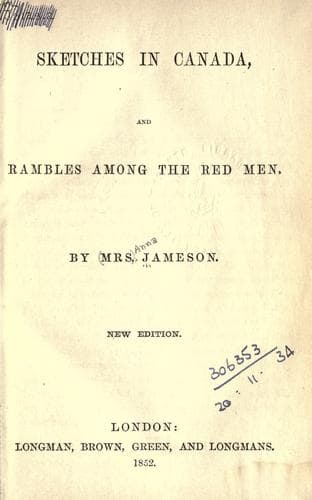
Sketches in Canada, and rambles among the red menJameson, Mrs. (Anna)
History
Sketches in Canada, and rambles among the red men
Jameson, Mrs. (Anna)
Indians of North America -- Canada; Ontario -- Description and travel
The fur trade has long ceased upon these shores, once the scene of
bloody conflicts between the Hurons and the Missassaguas. The latter
were at length nearly extirpated; a wretched, degenerate remnant of the
tribe still continued to skulk about their old haunts and the
burial-place of their fathers, which is a high mound on the west bank of
the river, and close upon the lake. These were collected by the
Methodist missionaries into a village or settlement, about two miles
farther on, where an attempt has been made to civilise and convert them.
The government has expended a large sum in aid of this charitable
purpose, and about fifty log-huts have been constructed for the Indians,
each hut being divided by a partition, and capable of lodging two or
more families. There is also a chapel and a school-house. Peter Jones,
otherwise Kahkewaquonaby, a half-caste Indian, is the second chief and
religious teacher; he was in England a few years ago to raise
contributions for his people, and married a young enthusiastic
Englishwoman with a small property. She has recently quitted the village
to return to Europe. There is, besides, a regular Methodist preacher
established here, who cannot speak one word of the language of the
natives, nor hold any communion with them, except through an
interpreter. He complained of the mortality among the children, and the
yearly diminution of numbers in the settlement. The greater number of
those who remain are half-breeds, and of these, some of the young women
and children are really splendid creatures; but the general appearance
of the place and people struck me as gloomy. The Indians, whom I saw
wandering and lounging about, and the squaws wrapped in dirty blankets,
with their long black hair falling over their faces and eyes, filled me
with compassion. When the tribe were first gathered together, they
amounted to seven hundred men, women, and children; there are now about
two hundred and twenty. The missionary and his wife looked dejected; he
told me that the conference never allowed them (the missionaries) to
remain with any congregation long enough to know the people, or take a
personal interest in their welfare. In general the term of their
residence in any settlement or district was from two to three years, and
they were then exchanged for another. Among the inhabitants a few have
cultivated the portion of land allotted to them, and live in comparative
comfort; three or four women (half-caste) are favourably distinguished
by the cleanliness of their houses, and general good conduct; and some
of the children are remarkably intelligent, and can read both their own
language and English; but these are exceptions, and dirt, indolence,
and drunkenness, are but too general. Consumption is the prevalent
disease, and carries off numbers[3] of these wretched people.
Public-domain text, read in full here on John Shaqi.
Reviews
Reviews
No reviews yet
Be the first to share your thoughts on this work.
Join the Discussion
Join the discussion
Sign in to leave a comment or review.
Sign InorCreate an account