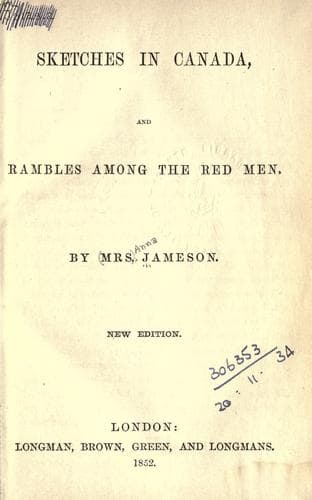
Sketches in Canada, and rambles among the red menJameson, Mrs. (Anna)
History
Sketches in Canada, and rambles among the red men
Jameson, Mrs. (Anna)
Indians of North America -- Canada; Ontario -- Description and travel
Before quitting the subject of Niagara, I may as well mention an
incident which occurred shortly afterwards, on my last visit to the
town, which interested me much at the time, and threw the whole of this
little community into a wonderful ferment.
THE SLAVE.
A black man, a slave somewhere in Kentucky, having been sent on a
message, mounted on a very valuable horse, seized the opportunity of
escaping. He reached Buffalo after many days of hard riding, sold the
horse, and escaped beyond the lines into Canada. Here, as in all the
British dominions, God be praised! the slave is slave no more, but free,
and protected in his freedom.[5] This man acknowledged that he had not
been ill treated; he had received some education, and had been a
favourite with his master. He gave as a reason for his flight, that he
had long wished to marry, but was resolved that his children should not
be born slaves. In Canada, a runaway slave is assured of legal
protection; but, by an international compact between the United States
and our provinces, all felons are mutually surrendered. Against this
young man the jury in Kentucky had found a true bill for horse-stealing;
as a felon, therefore, he was pursued, and, on the proper legal
requisition, arrested; and then lodged in the jail of Niagara, to be
given up to his master, who, with an American constable, was in
readiness to take him into custody, as soon as the government order
should arrive. His case excited a strong interest among the whites,
while the coloured population, consisting of many hundreds in the
districts of Gore and Niagara, chiefly refugees from the States, were
half frantic with excitement. They loudly and openly declared that they
would peril their lives to prevent his being carried again across the
frontiers, and surrendered to the vengeance of his angry master.
Meantime there was some delay about legal forms, and the mayor and
several of the inhabitants of the town united in a petition to the
governor in his favour. In this petition it was expressly mentioned,
that the master of the slave had been heard to avow that his intention
was not to give the culprit up to justice, but to make what he called an
_example_ of him. Now there had been lately some frightful instances of
what the slave proprietors of the south called "making an example;" and
the petitioners entreated the governor to interpose, and save the man
from a torturing death "under the lash or at the stake." Probably the
governor's own humane feelings pleaded even more strongly in behalf of
the poor fellow. But it was a case in which he could not act from
feeling, or, "to do a great right, do a little wrong." The law was too
expressly and distinctly laid down, and his duty as governor was clear
and imperative--to give up the felon, although, to have protected the
slave, he would, if necessary, have armed the province.
Public-domain text, read in full here on John Shaqi.
Reviews
Reviews
No reviews yet
Be the first to share your thoughts on this work.
Join the Discussion
Join the discussion
Sign in to leave a comment or review.
Sign InorCreate an account