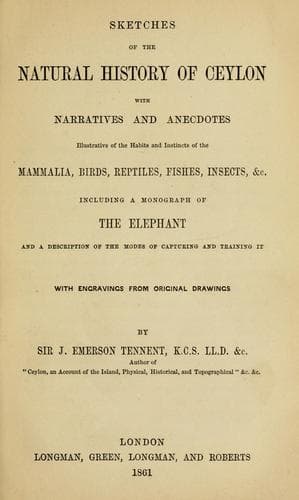
Sketches of the Natural History of CeylonTennent, James Emerson, Sir
Science
Sketches of the Natural History of Ceylon
Tennent, James Emerson, Sir
Animals -- Sri Lanka; Asiatic elephant -- Sri Lanka
[Footnote 2: The buffalo and the humped cattle of India, which are used
for draught and burden, have, I believe, a development of the
organisation of the reticulum which enables the ruminants generally, to
endure thirst, and abstain from water, somewhat more conspicuous than in
the rest of their congeners; but nothing that approaches in singularity
of character to the distinct cavities in the stomach exhibited by the
three animals above alluded to.]
The _food_ of the elephant is so abundant, that in feeding he never
appears to be impatient or voracious, but rather to play with the leaves
and branches on which he leisurely feeds. In riding by places where a
herd has recently halted, I have sometimes seen the bark peeled
curiously off the twigs, as though it had been done in mere dalliance.
In the same way in eating grass the elephant selects a tussac which he
draws from the ground by a dexterous twist of his trunk, and nothing can
be more graceful than the ease with which, before conveying it to his
mouth, he beats the earth from its roots by striking it gently upon his
fore-leg. A coco-nut he first rolls under foot, to detach the strong
outer bark, then stripping off with his trunk the thick layer of fibre
within, he places the shell in his mouth, and swallows with evident
relish the fresh liquid which flows as he crushes it between his
grinders.
The natives of the peninsula of Jaffna always look for the periodical
appearance of the elephants, at the precise time when the fruit of the
palmyra palm begins to fall to the ground from ripeness. In like manner
in the eastern provinces where the custom prevails of cultivating what
is called _chena_ land (by clearing a patch of forest for the purpose of
raising a single crop, after which the ground is abandoned, and reverts
to jungle again), although a single elephant may not have been seen in
the neighbourhood during the early stages of the process, the Moormen,
who are the cultivators of this class, will predict their appearance
with almost unerring confidence so soon as the grains shall have begun
to ripen; and although the crop comes to maturity at different periods
in different districts, herds are certain to be seen at each in
succession, as soon as it is ready to be cut. In these well-timed
excursions, they resemble the bison of North America, which, by a
similarly mysterious instinct, finds its way to portions of the distant
prairies, where accidental fires have been followed by a growth of
tender grass. Although the fences around these _chenas_ are little more
than lines of reeds loosely fastened together, they are sufficient, with
the presence of a single watcher, to prevent the entrance of the
elephants, who wait patiently till the rice and _coracan_ have been
removed, and the watcher withdrawn; and, then finding gaps in the fence,
they may be seen gleaning among the leavings and the stubble; and they
take their departure when these are exhausted, apparently in the
Public-domain text, read in full here on John Shaqi.
Reviews
Reviews
No reviews yet
Be the first to share your thoughts on this work.
Elsewhere in the archive
Join the Discussion
Join the discussion
Sign in to leave a comment or review.
Sign InorCreate an account