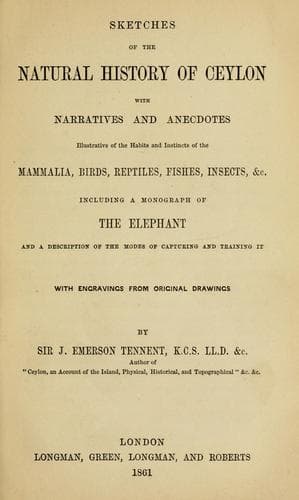
Sketches of the Natural History of CeylonTennent, James Emerson, Sir
Science
Sketches of the Natural History of Ceylon
Tennent, James Emerson, Sir
Animals -- Sri Lanka; Asiatic elephant -- Sri Lanka
direction of some other _chena_, which they have ascertained to be about
to be cut.
There is something still unexplained in the dread which an elephant
always exhibits on approaching a fence, and the reluctance which he
displays to face the slightest artificial obstruction to his passage. In
the fine old tank of Tissa-weva, close by Anarajapoora, the natives
cultivate grain, during the dry season, around the margin where the
ground has been left bare by the subsidence of the water. These little
patches of rice they enclose with small sticks an inch in diameter and
five or six feet in height, such as would scarcely serve to keep out a
wild hog if he attempted to force his way through. Passages of from ten
to twenty feet wide are left between each field, to permit the wild
elephants, which abound in the vicinity to make their nocturnal visits
to the water still remaining in the tank. Night after night these open
pathways are frequented by immense herds, but the tempting corn is never
touched, nor is a single fence disturbed, although the merest, movement
of a trunk would be sufficient to demolish the fragile structure. Yet
the same spots, the fences being left open as soon as the grain has been
cut and carried home, are eagerly entered by the elephants to glean
amongst the stubble.
Sportsmen observe that an elephant, even when enraged by a wound, will
hesitate to charge an assailant across an intervening hedge, but will
hurry along it to seek for an opening. It is possible that, on the part
of the elephant, there may be some instinctive consciousness, that owing
to his superior bulk, he is exposed to danger from sources that might be
perfectly harmless in the case of lighter animals, and hence his
suspicion that every fence may conceal a snare or pitfall. Some similar
apprehension is apparent in the deer, which shrinks from attempting a
fence of wire, although it will clear without hesitation a solid wall of
greater height.
At the same time, the caution with which the elephant is supposed to
approach insecure ground and places of doubtful[1] solidity, appears to
me, so far as my own observation and experience extend, to be
exaggerated, and the number of temporary bridges which are annually
broken down by elephants in all parts of Ceylon, is sufficient to show
that, although in captivity, and when familiar with such structures, the
tame ones may, and doubtless do, exhibit all the wariness attributed to
them; yet, in a state of liberty, and whilst unaccustomed to such
artificial appliances, their instincts are not sufficient to ensure
their safety. Besides, the fact is adverted to elsewhere[2], that the
chiefs of the Wanny, during the sovereignty of the Dutch, were
accustomed to take in pitfalls the elephants which they rendered as
tribute to government.
Public-domain text, read in full here on John Shaqi.
Reviews
Reviews
No reviews yet
Be the first to share your thoughts on this work.
Elsewhere in the archive
Join the Discussion
Join the discussion
Sign in to leave a comment or review.
Sign InorCreate an account