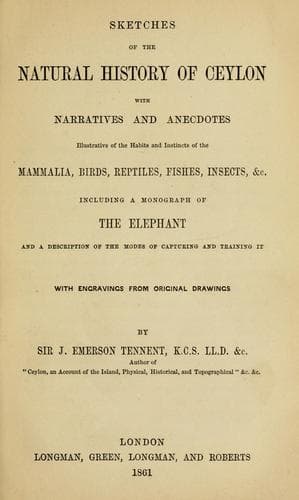
Sketches of the Natural History of CeylonTennent, James Emerson, Sir
Science
Sketches of the Natural History of Ceylon
Tennent, James Emerson, Sir
Animals -- Sri Lanka; Asiatic elephant -- Sri Lanka
The shooting of elephants in Ceylon has been described with tiresome
iteration in the successive journals of sporting gentlemen, but one who
turns to their pages for traits of the animal and his instincts is
disappointed to find little beyond graphic sketches of the daring and
exploits of his pursuers, most of whom, having had no further
opportunity of observation than is derived from a casual encounter with
the outraged animal, have apparently tried to exalt their own prowess,
by misrepresenting the ordinary character of the elephant, describing
him as "savage, wary, and revengeful."[1]
These epithets may undoubtedly apply to the outcasts from the herd, the
"Rogues" or _hora allia_, but so small is the proportion of these that
there is not probably one _rogue_ to be found for every five hundred of
those in herds; and it is a manifest error, arising from imperfect
information, to extend this censure to them generally, or to suppose the
elephant to be an animal "thirsting for blood, lying in wait in the
jungle to rush on the unwary passer-by, and knowing no greater pleasure
than the act of crushing his victim to a shapeless mass beneath his
feet."[2] The cruelties practised by the hunters have no doubt taught
these sagacious creatures to be cautious and alert, but their
precautions are simply defensive; and beyond the alarm and apprehension
which they evince on the approach of man, they exhibit no indication of
hostility or thirst for blood.
[Footnote 1: _The Rifle and the Hound in Ceylon_; by S.W. BAKER, Esq.,
pp. 8, 9. "Next to a rogue," says Mr. BAKER, "in ferocity, and even more
persevering in the pursuit of her victim, is a female elephant." But he
appends the significant qualification, "_when her young one has been
killed_."--_Ibid_., p. 13.]
[Footnote 2: _Ibid_.]
An ordinary traveller seldom comes upon elephants unless after sunset or
towards daybreak, as they go to or return from their nightly visits to
the tanks: but when by accident a herd is disturbed by day, they evince,
if unattacked, no disposition to become assailants; and if the attitude
of defence which they instinctively assume prove sufficent to check the
approach of the intruder, no further demonstration is to be apprehended.
Even the hunters who go in search of them find them in positions and
occupations altogether inconsistent with the idea of their being savage,
wary, or revengeful. Their demeanour when undisturbed is indicative of
gentleness and timidity, and their actions bespeak lassitude and
indolence, induced not alone by heat, but probably ascribable in some
degree to the fact that the night has been spent in watchfulness and
amusement. A few are generally browsing listlessly on the trees and
plants within reach, others fanning themselves with leafy branches, and
a few are asleep; whilst the young run playfully among the herd, the
emblems of innocence, as the older ones are of peacefulness and gravity.
Public-domain text, read in full here on John Shaqi.
Reviews
Reviews
No reviews yet
Be the first to share your thoughts on this work.
Elsewhere in the archive
Join the Discussion
Join the discussion
Sign in to leave a comment or review.
Sign InorCreate an account