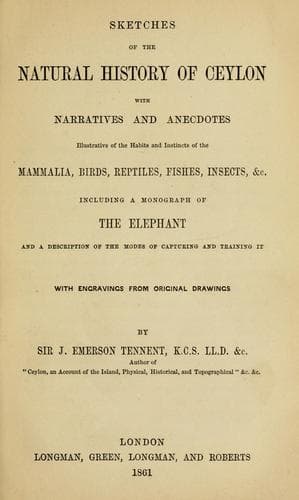
Sketches of the Natural History of CeylonTennent, James Emerson, Sir
Science
Sketches of the Natural History of Ceylon
Tennent, James Emerson, Sir
Animals -- Sri Lanka; Asiatic elephant -- Sri Lanka
Almost every elephant may be observed to exhibit some peculiar action of
the limbs when standing at rest; some move the head monotonously in a
circle, or from right to left; some swing their feet back and forward;
others flap their ears or sway themselves from side to side, or rise and
sink by alternately bending and straightening the fore knees. As the
opportunities of observing this custom have been almost confined to
elephants in captivity, it has been conjectured to arise from some
morbid habit contracted during the length of a voyage by sea[1], or from
an instinctive impulse to substitute a motion of this kind in lieu of
their wonted exercise; but this supposition is erroneous; the propensity
being equally displayed by those at liberty and those in captivity. When
surprised by sportsmen in the depths of the jungle, individuals of a
herd are always occupied in swinging their limbs in this manner; and in
the several corrals which I have seen, where whole herds have been
captured, the elephants in the midst of the utmost excitement, and even
after the most vigorous charges, if they halted for a moment in stupor
and exhaustion, manifested their wonted habit, and swung their limbs or
swayed their bodies to and fro incessantly. So far from its being a
substitute for exercise, those in the government employment in Ceylon
are observed to practise their acquired motion, whatever it may be, with
increased vigour when thoroughly fatigued after excessive work. Even the
favourite practice of fanning themselves with a leafy branch seems less
an enjoyment in itself than a resource when listless and at rest. The
term "fidgetty" seems to describe appropriately the temperament of the
elephant.
[Footnote 1: _Menageries_, &c., "The Elephant," ch. i. p. 21.]
They evince the strongest love of retirement and a corresponding dislike
to intrusion. The approach of a stranger is perceived less by the eye,
the quickness of which is not remarkable (besides which its range is
obscured by the foliage), than by sensitive smell and singular acuteness
of hearing; and the whole herd is put in instant but noiseless motion
towards some deeper and more secure retreat. The effectual manner in
which an animal of the prodigious size of the elephant can conceal
himself, and the motionless silence which he preserves, is quite
surprising; whilst beaters pass and repass within a few yards of his
hiding place, he will maintain his ground till the hunter, creeping
almost close to his legs, sees his little eye peering out through the
leaves, when, finding himself discovered, the elephant breaks away with
a crash, levelling the brushwood in his headlong career.
Public-domain text, read in full here on John Shaqi.
Reviews
Reviews
No reviews yet
Be the first to share your thoughts on this work.
Elsewhere in the archive
Join the Discussion
Join the discussion
Sign in to leave a comment or review.
Sign InorCreate an account