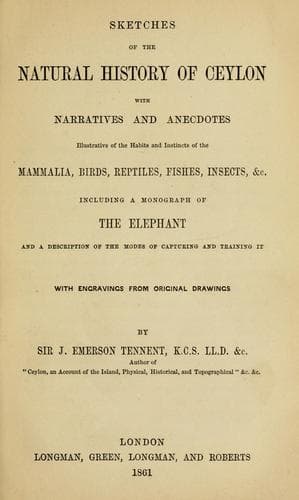
Sketches of the Natural History of CeylonTennent, James Emerson, Sir
Science
Sketches of the Natural History of Ceylon
Tennent, James Emerson, Sir
Animals -- Sri Lanka; Asiatic elephant -- Sri Lanka
As regards boldness and courage, a strange variety of temperament is
observable amongst elephants, but it may be affirmed that they are, much
more generally timid than courageous. One herd may be as difficult to
approach as deer, gliding away through the jungle so gently and quickly
that scarcely a trace marks their passage; another, in apparent stupor,
will huddle themselves together like swine, and allow their assailant to
come within a few yards before they break away in terror; and a third
will await his approach without motion, and then advance, with fury to
the "charge."
In individuals the same differences are discernible; one flies on the
first appearance of danger, whilst another, alone and unsupported, will
face a whole host of enemies. When wounded and infuriated with pain,
many of them become literally savage[1]; but, so unaccustomed are they
to act as assailants, and so awkward and inexpert in using their
strength, that they rarely or ever exceed in killing a pursuer who falls
into their power. Although the pressure of a foot, a blow with the
trunk, or a thrust with the tusk, could scarcely fail to prove fatal,
three-fourths of those who have fallen into their power have escaped
without serious injury. So great is this chance of impunity, that the
sportsman prefers to approach within about fifteen paces of the
advancing elephant, a space which gives time for a second fire should
the first shot prove ineffectual, and should both fail there is still
opportunity for flight.
[Footnote 1: Some years ago an elephant which had been wounded by a
native, near Hambangtotte, pursued the man into the town, followed him
along the street, trampled him to death in the bazaar before a crowd of
spectators, and succeeded in making good its retreat to the jungle.]
Amongst full-grown timber, a skilful runner can escape from an elephant
by "dodging" round the trees, but in cleared land, and low brushwood,
the difficulty is much increased, as the small growth of underwood which
obstructs the movements of man presents no obstacle to those of an
elephant. On the other hand, on level and open ground the chances are
rather in favour of the elephant, as his pace in full flight exceeds
that of man, although as a general rule, it is unequal to that of a
horse, as has been sometimes asserted.[1]
[Footnote 1: SHAW, in his _Zoology_, asserts that an elephant can run as
swiftly as a horse can gallop. London, 1800-6, vol. i. p. 216.]
Public-domain text, read in full here on John Shaqi.
Reviews
Reviews
No reviews yet
Be the first to share your thoughts on this work.
Elsewhere in the archive
Join the Discussion
Join the discussion
Sign in to leave a comment or review.
Sign InorCreate an account