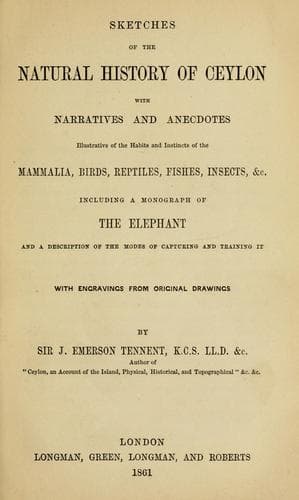
Sketches of the Natural History of CeylonTennent, James Emerson, Sir
Science
Sketches of the Natural History of Ceylon
Tennent, James Emerson, Sir
Animals -- Sri Lanka; Asiatic elephant -- Sri Lanka
The incessant slaughter of elephants by sportsmen in Ceylon, appears to
be merely in subordination to the influence of the organ of
destructiveness, since the carcase is never applied to any useful
purpose, but left to decompose and to defile the air of the forest. The
flesh is occasionally tasted as a matter of curiosity: as a steak it is
coarse and tough; but the tongue is as delicate as that of an ox; and
the foot is said to make palatable soup. The Caffres attached to the
pioneer corps in the Kandyan province are in the habit of securing the
heart of any elephant shot in their vicinity, and say it is their custom
to eat it in Africa. The hide it has been found impracticable to tan in
Ceylon, or to convert to any useful purpose, but the bones of those shot
have of late years been collected and used for manuring coffee estates.
The hair of the tail, which is extremely strong and horny, is mounted by
the native goldsmith, and made into bracelets; and the teeth are sawn by
the Moormen at Galle (as they used to be by the Romans during a scarcity
of ivory) into plates, out of which they fashion numerous articles of
ornament, knife-handles, card racks, and "presse-papiers."
NOTE.
Amongst extraordinary recoveries from desperate wounds, I venture to
record here an instance which occurred in Ceylon to a gentleman while
engaged in the chase of elephants, and which, I apprehend, has few
parallels in pathological experience. Lieutenant GERARD FRETZ, of the
Ceylon Rifle Regiment, whilst firing at an elephant in the vicinity of
Fort MacDonald, in Oovah, was wounded in the face by the bursting of his
fowling-piece, on the 22nd January, 1828. He was then about thirty-two
years of age. On raising him, it was found that part of the breech of
the gun and about two inches of the barrel had been driven through the
frontal sinus, at the junction of the nose and forehead. It had sunk
almost perpendicularly till the iron-plate called "the tail-pin," by
which the barrel is made fast to the stock by a screw, had descended
through the palate, carrying with it the screw, one extremity of which
had forced itself into the right nostril, where it was discernible
externally, whilst the headed end lay in contact with his tongue. To
extract the jagged mass of iron thus sunk in the ethmoidal and
sphenoidal cells was found hopelessly impracticable; but, strange to
tell, after the inflammation subsided, Mr. FRETZ recovered rapidly; his
general health was unimpaired, and he returned to his regiment with
this, singular appendage firmly embedded behind the bones of his face.
He took his turn of duty as usual, attained the command of his company,
participated in all the enjoyments of the mess-room, and died _eight
years afterwards_, on the 1st of April, 1836, not from any consequences
of this fearful wound, but from fever and inflammation brought on by
other causes.
Public-domain text, read in full here on John Shaqi.
Reviews
Reviews
No reviews yet
Be the first to share your thoughts on this work.
Elsewhere in the archive
Join the Discussion
Join the discussion
Sign in to leave a comment or review.
Sign InorCreate an account