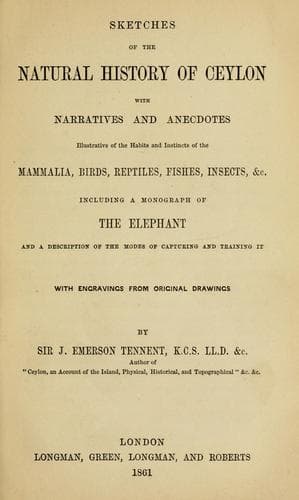
Sketches of the Natural History of CeylonTennent, James Emerson, Sir
Science
Sketches of the Natural History of Ceylon
Tennent, James Emerson, Sir
Animals -- Sri Lanka; Asiatic elephant -- Sri Lanka
[Footnote 1: The device of taking them by means of pitfalls still
prevails in India: but in addition to the difficulty of providing
against that caution with which the elephant is supposed to reconnoitre
suspicious ground, it has the further disadvantage of exposing him to
injury from bruises and dislocations in his fall. Still it was the mode
of capture employed by the Singhalese, and so late as 1750 WOLF relates
that the native chiefs of the Wanny, when capturing elephants for the
Dutch, made "pits some fathoms deep in those places whither the elephant
is wont to go in search of food, across which were laid poles covered
with branches and baited with the food of which he is fondest, making
towards which he finds himself taken unawares. Thereafter being subdued
by fright and exhaustion, he was assisted to raise himself to the
surface by means of hurdles and earth, which he placed underfoot as they
were thrown down to him, till he was enabled to step out on solid
ground, when the noosers and decoys were in readiness to tie him up to
the nearest tree."--See WOLF'S _Life and Adventures_, p. 152. Shakspeare
appears to have been acquainted with the plan of taking elephants in
pitfalls: Decius, encouraging the conspirators, reminds them of Cæsar's
taste for anecdotes of animals, by which he would undertake to lure him
to his fate:
"For he loves to hear
That unicorns may be betrayed with trees.
And bears with glasses; _elephants with holes_."
JULIUS CÆSAR, Act ii. Scene I.]
Knox describes with circumstantiality the mode adopted, two centuries
ago, by the servants of the King of Kandy to catch elephants for the
royal stud. He says, "After discovering the retreat of such as have
tusks, unto these they drive some _she elephants_, which they bring with
them for the purpose, which, when once the males have got a sight of,
they will never leave, but follow them wheresoever they go; and the
females are so used to it that they will do whatsoever, either by word
or a beck, their keepers bid them. And so they delude them along through
towns and countries, and through the streets of the city, even to the
very gates of the king's palace, where sometimes they seize upon them by
snares, and sometimes by driving them into a kind of pound, they catch
them."[1]
[Footnote 1: KNOX'S _Historical Relation of Ceylon_, A.D. 1681, part i.
ch. vi. p. 21.]
Public-domain text, read in full here on John Shaqi.
Reviews
Reviews
No reviews yet
Be the first to share your thoughts on this work.
Elsewhere in the archive
Join the Discussion
Join the discussion
Sign in to leave a comment or review.
Sign InorCreate an account