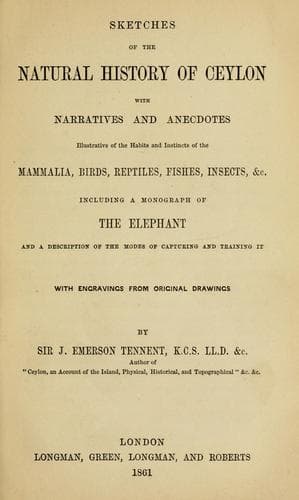
Sketches of the Natural History of CeylonTennent, James Emerson, Sir
Science
Sketches of the Natural History of Ceylon
Tennent, James Emerson, Sir
Animals -- Sri Lanka; Asiatic elephant -- Sri Lanka
So little was he apparently inconvenienced by the presence of the
strange body in his palate that he was accustomed with his finger
partially to undo the screw, which but for its extreme length he might
altogether have withdrawn. To enable this to be done, and possibly to
assist by this means the extraction of the breech itself through the
original orifice (which never entirely closed), an attempt was made in
1835 to take off a portion of the screw with a file; but, after having
cut it three parts through the operation was interrupted, chiefly owing
to the carelessness and indifference of Capt. FRETZ, whose death
occurred before the attempt could be resumed. The piece of iron, on
being removed after his decease, was found to measure 2-3/4 inches in
length, and weighed two scruples more than two ounces and three
quarters. A cast of the breech and screw now forms No. 2790 amongst the
deposits in the Medical Museum of Chatham.
CHAP. V.
THE ELEPHANT.
* * * * *
_An Elephant Corral_.
So long as the elephants of Ceylon were merely required in small numbers
for the pageantry of the native princes, or the sacred processions of
the Buddhist temples, their capture was effected either by the
instrumentality of female decoys, or by the artifices and agility of the
individuals and castes who devoted themselves to their pursuit and
training. But after the arrival of the European conquerors of the
island, and when it had become expedient to take advantage of the
strength and intelligence of these creatures in clearing forests and
making roads and other works, establishments were organised on a great
scale by the Portuguese and Dutch, and the supply of elephants kept up
by periodical battues conducted at the cost of the government, on a plan
similar to that adopted on the continent of India, when herds varying in
number from twenty to one hundred and upwards are driven into concealed
enclosures and secured.
In both these processes, success is entirely dependent on the skill with
which the captors turn to advantage the terror and inexperience of the
wild elephant, since all attempts would be futile to subdue or confine
by ordinary force an animal of such strength and sagacity.[1]
Public-domain text, read in full here on John Shaqi.
Reviews
Reviews
No reviews yet
Be the first to share your thoughts on this work.
Elsewhere in the archive
Join the Discussion
Join the discussion
Sign in to leave a comment or review.
Sign InorCreate an account