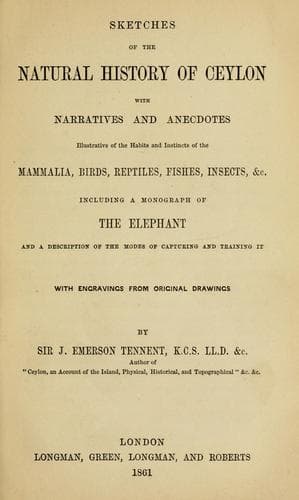
Sketches of the Natural History of CeylonTennent, James Emerson, Sir
Science
Sketches of the Natural History of Ceylon
Tennent, James Emerson, Sir
Animals -- Sri Lanka; Asiatic elephant -- Sri Lanka
Amongst the last of the elephants noosed was the rogue. Though far more
savage than the others, he joined in none of their charges and assaults
on the fences, as they uniformly drove him off and would not permit him
to enter their circle. When dragged past another of his companions in
misfortune, who was lying exhausted on the ground, he flew upon him and
attempted to fasten his teeth in his head; this was the only instance of
viciousness which occurred during the progress of the corral. When tied
up and overpowered, he was at first noisy and violent, but soon lay down
peacefully, a sign, according to the hunters, that his death was at
hand. Their prognostication was correct; he continued for about twelve
hours to cover himself with dust like the others, and to moisten it with
water from his trunk; but at length he lay exhausted, and died so
calmly, that having been moving but a few moment before, his death was
only perceived by the myriads of black flies by which his body was
almost instantly covered, although not one was visible a moment
before.[1] The Rodiyas were called in to loose the ropes that bound him,
from the tree, and two tame elephants being harnessed to the dead body,
it was dragged to a distance without the corral.
[Footnote 1: The surprising faculty of vultures for discovering carrion,
has been a subject of much speculation, as to whether it be dependent on
their power of sight or of scent. It is not, however, more mysterious
than the unerring certainty and rapidity with which some of the minor
animals, and more especially insects, in warm climates congregate around
the offal on which they feed. Circumstanced as they are, they must be
guided towards their object mainly if not exclusively by the sense of
smell; but that which excites astonishment is the small degree of odour
which seems to suffice for the purpose; the subtlety and rapidity with
which it traverses and impregnates the air; and the keen and quick
perception with which it is taken up by the organs of those creatures.
The instance of the scavenger beetles has been already alluded to; the
promptitude with which they discern the existence of matter suited to
their purposes, and the speed with which they hurry to it from all
directions; often from distances as extraordinary, proportionably, as
those traversed by the eye of the vulture. In the instance of the dying
elephant referred to above, life was barely extinct when the flies, of
which not one was visible but a moment before, arrived in clouds and
blackened the body by their multitude; scarcely an instant was allowed
to elapse for the commencement of decomposition; no odour of
putrefaction could be discerned by us who stood close by; yet some
peculiar smell of mortality, simultaneously with parting breath, must
have summoned them to the feast. Ants exhibit an instinct equally
surprising. I have sometimes covered up a particle of refined sugar with
paper on the centre of a polished table; and counted the number of
Public-domain text, read in full here on John Shaqi.
Reviews
Reviews
No reviews yet
Be the first to share your thoughts on this work.
Elsewhere in the archive
Join the Discussion
Join the discussion
Sign in to leave a comment or review.
Sign InorCreate an account