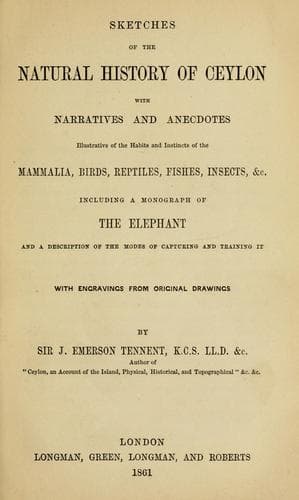
Sketches of the Natural History of CeylonTennent, James Emerson, Sir
Science
Sketches of the Natural History of Ceylon
Tennent, James Emerson, Sir
Animals -- Sri Lanka; Asiatic elephant -- Sri Lanka
minutes which would elapse before it was fastened on by the small black
ants of Ceylon, and a line formed to lower it safely to the floor. Here
was a substance which, to our apprehension at least, is altogether
inodorous, and yet the quick sense of smell must have been the only
conductor of the ants. It has been observed of those fishes which travel
overland on the evaporation of the ponds in which they live, that they
invariably march in the direction of the nearest water, and even when
captured, and placed on the floor of a room, their efforts to escape are
always made towards the same point. Is the sense of smell sufficient to
account for this display of instinct in them? or is it aided by special
organs in the case of the others? Dr. MCGEE, formerly of the Royal Navy,
writing to me on the subject of the instant appearance of flies in the
vicinity of dead bodies, says: "In warm climates they do not wait for
death to invite them to the banquet. In Jamaica I have again and again
seen them settle on a patient, and hardly to be driven away by the
nurse, the patient himself saying. 'Here are these flies coming to eat
me ere I am dead.' At times they have enabled the doctor, when otherwise
he would have been in doubt as to his prognosis, to determine whether
the strange apyretic interval occasionally present in the last stage of
yellow fever was the fatal lull or the lull of recovery; and 'What say
the flies?' has been the settling question. Among many, many cases
during a long period I have seen but one recovery after the assembling
of the flies. I consider the foregoing as a confirmation of smell being
the guide even to the attendants, a cadaverous smell has been perceived
to arise from the body of a patient twenty-four hours before death."]
When every wild elephant had been noosed and tied up, the scene
presented was truly oriental. From one to two thousand natives, many of
them in gaudy dresses and armed with spears, crowded about the
enclosures. Their families had collected to see the spectacle; women,
whose children clung like little bronzed Cupids by their sides; and
girls, many of them in the graceful costume of that part of the
country,--a scarf, which, after having been brought round the waist, is
thrown over the left shoulder, leaving the right arm and side free and
uncovered.
Public-domain text, read in full here on John Shaqi.
Reviews
Reviews
No reviews yet
Be the first to share your thoughts on this work.
Elsewhere in the archive
Join the Discussion
Join the discussion
Sign in to leave a comment or review.
Sign InorCreate an account