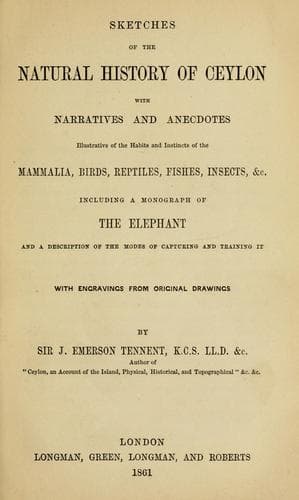
Sketches of the Natural History of CeylonTennent, James Emerson, Sir
Science
Sketches of the Natural History of Ceylon
Tennent, James Emerson, Sir
Animals -- Sri Lanka; Asiatic elephant -- Sri Lanka
"Il faut remarquer ici une chose qu'on aura peut-être de la peine à
croire main quit est toutefois très-véritable: c'est que lorsque quelque
roi on quelque seigneur a quelqu'un de ces éléphants de Ceylan, et qu'on
en amène quelqu'autre des lieux où les marchands vont les prendre, comme
d'Achen, de Siam, d'Arakan, de Pegu, du royáume de Boutan, d'Assam, des
terres de Cochin et de la coste du Mélinde, dés que les éléphants en
voient un de Ceylan, par un instinct de nature, ils lui font la
révérence, portant le bout de leur trompe à la terre et la relevant. Il
est vrai que les éléphants que les grand seigneurs entretiennent, quand
en les amine devant eux, pour voir s'ils sent en bon point, font troi
fois une espére de révérence avec leur troupe, _a que j'ai en souvent_,
mais ils sont stylés à cela, et leurs maitres le leur enseignent de
bonne heure."--_Les Six Voyages de_ J.B. TAVERNIER, lib. iii. ch. 20.]
[Footnote 3: _Ramayana_, sec. vi.: CAREY and MARSHMAN, i. 105: FAUCHE,
t. i. p. 66.]
The earliest knowledge of the elephant in Europe and the West, was
derived from the conspicuous position assigned to it in the wars of the
East: in India, from the remotest antiquity, it formed one of the most
picturesque, if not the most effective, features in the armies of the
native princes.[1] It is more than probable that the earliest attempts
to take and train the elephant, were with a view to military uses, and
that the art was perpetuated in later times to gratify the pride of the
eastern kings, and sustain the pomp of their processions.
[Footnote 1: The only mention of the elephant in Sacred History in the
account given in _Maccabees_ of the invasion of Egypt by Antiochus, who
entered it 170 B.C., "with chariots and elephants, and horsemen, and a
great navy."--1 _Macc_. i. 17. Frequent allusions to the use of
elephants in war occur in both books: and in chap. vi. 34, it is stated
that "to provoke the elephants to fight they showed them the blood of
grapes and of mulberries." The term showed, "[Greek: edeixan]," might be
thought to imply that the animals were enraged by the sight of the wine
and its colour, but in the Third Book of Maccabees, in the Greek
Septuagint, various other passages show that wine, on such occasions,
was administered to the elephants to render them furious.--Mace, v. 2.
10, 45. PHILE mentions the same fact, _De Elephante_, i. 145.
Public-domain text, read in full here on John Shaqi.
Reviews
Reviews
No reviews yet
Be the first to share your thoughts on this work.
Elsewhere in the archive
Join the Discussion
Join the discussion
Sign in to leave a comment or review.
Sign InorCreate an account