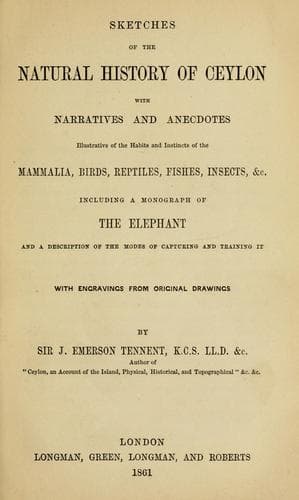
Sketches of the Natural History of CeylonTennent, James Emerson, Sir
Science
Sketches of the Natural History of Ceylon
Tennent, James Emerson, Sir
Animals -- Sri Lanka; Asiatic elephant -- Sri Lanka
There is a very curious account of the mode in which the Arab conquerors
of Seinde, in the 9th and 10th centuries, equipped the elephant for war;
which being written with all the particularity of an eye-witness, bears
the impress of truth and accuracy. MASSOUDI, who was born in Bagdad at
the close of the 9th century, travelled in India in the year A.D. 913,
and visited the Gulf of Cambay, the coast of Malabar, and the Island of
Ceylon:--from a larger account of his journeys he compiled a summary
under the title of "_Moroudj al-dzeheb," or the "Golden Meadows_," the
MS. of which is now in the Bibliothèque Nationale. M. REINAUD, in
describing this manuscript says on its authority, "The Prince of
Mensura, whose dominions lay south of the Indus, maintained eighty
elephants trained for war, each of which bore in his trunk a bent
cymeter (carthel), with which he was taught to cut and thrust at all
confronting him. The trunk itself was effectually protected by a coat of
mail, and the rest of the body enveloped in a covering composed jointly
of iron and horn. Other elephants were employed in drawing chariots,
carrying baggage, and grinding forage, and the performance of all
bespoke the utmost intelligence and docility."--REINAUD, _Mèmoires sur
l'Inde, antérieurement au milieu du XIe siècle, d'après les écrivains
arabes, persans et chinois_. Paris, M.D.CCC. XLIX. p. 215. See
SPRENGER'S English Translation of Massoudi, vol. i. p. 383.]
An impression prevails even to the present day, that the process of
training is tedious and difficult, and the reduction of a full-grown
elephant to obedience, slow and troublesome in the extreme.[1] In both
particulars, however, the contrary is the truth. The training as it
prevails in Ceylon is simple, and the conformity and obedience of the
animal are developed with singular rapidity. For the first three days,
or till they will eat freely, which they seldom do in a less time, the
newly-captured elephants are allowed to stand quiet; and, if
practicable, a tame elephant is tied near to give the wild ones
confidence. Where many elephants are being trained at once, it is
customary to put every new captive between the stalls of half-tamed
ones, when it soon takes to its food. This stage being attained,
training commences by placing tame elephants on either side. The
"cooroowe vidahn," or the head of the stables, stands in front of the
wild elephants holding a long stick with a sharp iron point. Two men are
then stationed one on either side, assisted by the tame elephants, and
each holding a _hendoo_ or crook[2] towards the wild one's trunk, whilst
one or two others rub their hands over his back, keeping up all the
while a soothing and plaintive chaunt, interlarded with endearing
epithets, such as "ho! my son," or "ho! my father," or "my mother," as
may be applicable to the age and sex of the captive. The elephant is at
first furious, and strikes in all directions with his trunk; but the men
Public-domain text, read in full here on John Shaqi.
Reviews
Reviews
No reviews yet
Be the first to share your thoughts on this work.
Elsewhere in the archive
Join the Discussion
Join the discussion
Sign in to leave a comment or review.
Sign InorCreate an account