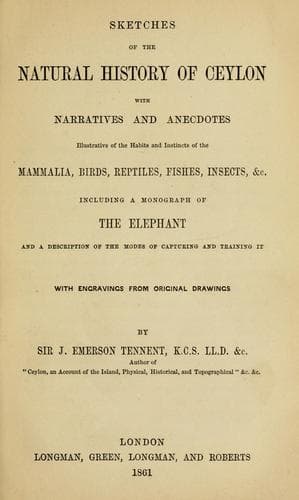
Sketches of the Natural History of CeylonTennent, James Emerson, Sir
Science
Sketches of the Natural History of Ceylon
Tennent, James Emerson, Sir
Animals -- Sri Lanka; Asiatic elephant -- Sri Lanka
[Footnote 1: The natives profess that the high caste elephants, such as
are allotted to the temples, are of all others the most difficult to
tame, and M. BLES, the Dutch correspondent of BUFFON, mentions a caste
of elephants which he had heard of, as being peculiar to the Kandyan
kingdom, that were not higher than a heifer (génisse), covered with
hair, and insusceptible of being tamed. (BUFFON, _Supp._ vol. vi. p.
29.) Bishop HEBER, in the account of his journey from Bareilly towards
the Himalayas, describes the Raja Gourman Sing, "mounted on a little
female elephant, hardly bigger than a Durham ox, and almost as shaggy as
a poodle."--_Journx._, ch. xvii. It will be remembered that the mammoth
discovered in 1803 embedded in icy soil in Siberia, was covered with a
coat of long hair, with a sort of wool at the roots. Hence there arose
the question whether that northern region had been formerly inhabited by
a race of elephants, so fortified by nature against cold; or whether the
individual discovered had been borne thither by currents from some more
temperate latitudes. To the latter theory the presence of hair seemed a
fatal objection; but so far as my own observation goes, I believe the
elephants are more or less provided with hair. In some it is more
developed than in others, and it is particularly observable in the
young, which when captured are frequently covered with a woolly fleece,
especially about the head and shoulders. In the older individuals in
Ceylon, this is less apparent: and in captivity the hair appears to be
altogether removed by the custom of the mahouts to rub their skin daily
with oil and a rough lump of burned clay. See a paper on the subject,
_Asiat. Journ._ N.S. vol. xiv. p. 182, by Mr. G. FAIRHOLME.]
But whatever may be its natural gentleness and docility, the temper of
an elephant is seldom to be implicitly relied on in a state of captivity
and coercion. The most amenable are subject to occasional fits of
stubbornness; and even after years of submission, irritability and
resentment will unaccountably manifest themselves. It may be that the
restraints and severer discipline of training have not been entirely
forgotten; or that incidents which in ordinary health would be
productive of no demonstration whatever, may lead, in moments of
temporary illness, to fretfulness and anger. The knowledge of this
infirmity led to the popular belief recorded by PHILE, that the elephant
had _two hearts_, under the respective influences of which it evinced
ferocity of gentleness; subdued by the one to habitual tractability and
obedience, but occasionally roused by the other to displays of rage and
resistance.[1]
Public-domain text, read in full here on John Shaqi.
Reviews
Reviews
No reviews yet
Be the first to share your thoughts on this work.
Elsewhere in the archive
Join the Discussion
Join the discussion
Sign in to leave a comment or review.
Sign InorCreate an account