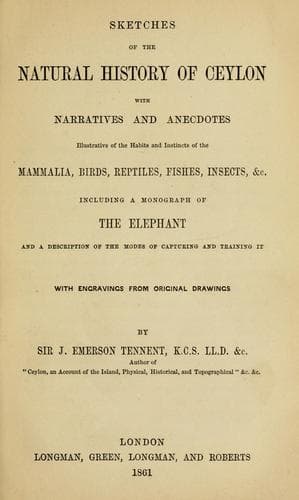
Sketches of the Natural History of CeylonTennent, James Emerson, Sir
Science
Sketches of the Natural History of Ceylon
Tennent, James Emerson, Sir
Animals -- Sri Lanka; Asiatic elephant -- Sri Lanka
The observation has been frequently made that the elephants most vicious
and troublesome to tame, and the most worthless when tamed, are those
distinguished by a thin trunk and flabby pendulous ears. The period of
tuition does not appear to be influenced by the size or strength of the
animals: some of the smallest give the greatest amount of trouble;
whereas, in the instance of the two largest that have been taken in
Ceylon within the last thirty years, both were docile in a remarkable
degree. One in particular, which was caught and trained by Mr. Cripps,
when Government agent, in the Seven Korles, fed from the hand the first
night it was secured, and in a very few days evinced pleasure on being
patted on the head.[1] There is none so obstinate, not even a _rogue_,
that may not, when kindly and patiently treated, be conciliated and
reconciled.
[Footnote 1: This was the largest elephant that had been tamed in
Ceylon; he measured upwards of nine feet at the shoulders and belonged
to the caste so highly prized for the temples. He was gentle after his
first capture, but his removal from the corral to the stables, though
only a distance of six miles, was a matter of the extremest difficulty;
his extraordinary strength rendering him more than a match for the
attendant decoys. He, on one occasion, escaped, but was recaptured in
the forest; and he afterwards became so docile as to perform a variety
of tricks. He was at length ordered to be removed to Colombo; but such
was his terror on approaching the gate, that on coaxing him to enter the
gate, he became paralysed in the extraordinary way elsewhere alluded to,
and _died on the spot_.]
The males are generally more unmaneagable than the females, and in both
an inclination to lie down to rest is regarded as a favourable symptom
of approaching tractability, some of the most resolute having been known
to stand for months together, even during sleep. Those which are the
most obstinate and violent at first are the soonest and most effectually
subdued, and generally prove permanently docile and submissive. But
those which are sullen or morose, although they may provoke no
chastisement by their viciousness, are always slower in being taught,
and are rarely to be trusted in after life.[1]
Public-domain text, read in full here on John Shaqi.
Reviews
Reviews
No reviews yet
Be the first to share your thoughts on this work.
Elsewhere in the archive
Join the Discussion
Join the discussion
Sign in to leave a comment or review.
Sign InorCreate an account