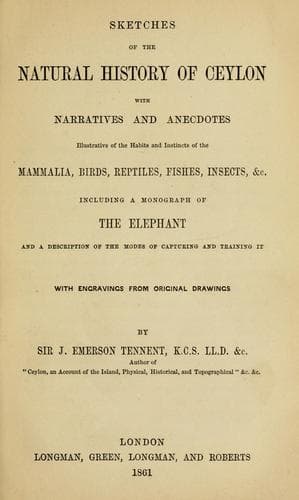
Sketches of the Natural History of CeylonTennent, James Emerson, Sir
Science
Sketches of the Natural History of Ceylon
Tennent, James Emerson, Sir
Animals -- Sri Lanka; Asiatic elephant -- Sri Lanka
The voice of the keeper, with a very limited vocabulary of articulate
sounds, serves almost alone to guide the elephant in his domestic
occupations.[1] Sir EVERARD HOME, from an examination of the muscular
fibres in the drum of an elephant's ear, came to the conclusion, that
notwithstanding the distinctness and power of his perception of sounds
at a greater distance than other animals, he was insensible to their
harmonious modulation and destitute of a musical ear.[2] But Professor
HARRISON, in a paper read before the Royal Irish Academy in 1847, has
stated that on a careful examination of the head of an elephant which he
had dissected, he could "see no evidence of the muscular structure of
the _membrana tympani_ so accurately described by Sir E. HOME." Sir
EVERARD'S deduction, I may observe, is clearly inconsistent with the
fact that the power of two elephants may be combined by singing to them
a measured chant, somewhat resembling a sailor's capstan song; and in
labour of a particular kind, such as hauling a stone with ropes, they
will thus move conjointly a weight to which their divided strength would
be unequal.[3]
[Footnote 1: The principal sound by which the mahouts in Ceylon direct
the motions of the elephants is a repetition, with various modulations,
of the words _ur-re! ur-re!_ This is one of those interjections in which
the sound is so expressive of the sense that persons in charge of
animals of almost every description throughout the world appear to have
adopted it with a concurrence that is very curious. The drivers of
camels in Turkey, Palestine, and Egypt encourage them to speed by
shouting _ar-ré! ar-ré!_ The Arabs in Algeria cry _eirich!_ to their
mules. The Moors seem to have carried the custom with them into Spain,
where mules are still driven with cries of _arré_ (whence the muleteers
derive their Spanish appellation of "arrieros"). In France the Sportsman
excites the hound by shouts of _hare! hare!_ and the waggoner there
turns his horses by his voice, and the use of the word _hurhaut!_ In the
North, "_Hurs_ was a word used by the old Germans in urging their horses
to speed;" and to the present day, the herdsmen in Ireland, and parts of
Scotland, drive their pigs with shouts of _hurrish!_ a sound closely
resembling that used by the mahouts in Ceylon.]
[Footnote 2: _On the Difference between the Human Membrana Tympani and
that of the Elephant_. By Sir EVERARD HOME, Bart., Philos. Trans., 1823.
Paper by Prof. HARRISON. Proc. Royal Irish Academy, vol. iii. p. 386.]
[Footnote 3: I have already noticed the striking effect produced on the
captive elephants in the corral, by the harmonious notes of an ivory
flute; and on looking to the graphic description which is given by ÆLIAN
of the exploits which he witnessed as performed by the elephants
exhibited at Rome, it is remarkable how very large a share of their
training appears to have been ascribed to the employment of music.
Public-domain text, read in full here on John Shaqi.
Reviews
Reviews
No reviews yet
Be the first to share your thoughts on this work.
Elsewhere in the archive
Join the Discussion
Join the discussion
Sign in to leave a comment or review.
Sign InorCreate an account