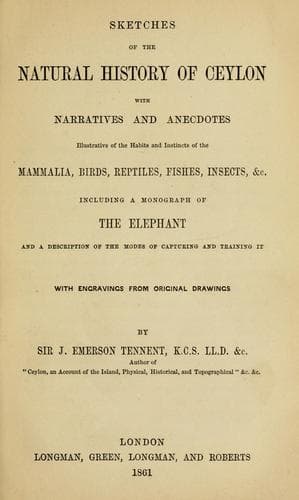
Sketches of the Natural History of CeylonTennent, James Emerson, Sir
Science
Sketches of the Natural History of Ceylon
Tennent, James Emerson, Sir
Animals -- Sri Lanka; Asiatic elephant -- Sri Lanka
PHILE, in the account which he has given of the elephant's fondness for
music, would almost seem to have versified the prose narrative of ÆLIAN,
as he describes its excitement at the more animated portions, its step
being regulated to the time and movements of the harmony: the whole
"_surprising in a creature whose limbs are without joints!_
[Greek:
"Kainon ti poiôn ex anarthrôn organôn."]
PHILE, _Expos. de Eleph_, 1. 216.
For an account of the training and performances of the elephants at
Rome, as narrated by ÆLIAN see the appendix to this chapter.]
Nothing can more strongly exhibit the impulse to obedience in the
elephant, than the patience with which, at the order of his keeper, he
swallows the nauseous medicines of the native elephant-doctors; and it
is impossible to witness the fortitude with which (without shrinking) he
submits to excruciating surgical operations for the removal of tumours
and ulcers to which he is subject, without conceiving a vivid impression
of his gentleness and intelligence. Dr. DAVY when in Ceylon was
consulted about an elephant in the government Stud, which was suffering
from a deep, burrowing sore in the back, just over the back-bone, which
had long resisted the treatment ordinarily employed. He recommended the
use of the knife, that issue might be given to the accumulated matter,
but no one of the attendants was competent to undertake the operation.
"Being assured," he continues, "that the creature would behave well, I
undertook it myself. The elephant was not bound, but was made to kneel
down at his keeper's command--and with an amputating knife, using all my
force, I made the incision required through the tough integuments. The
elephant did not flinch, but rather inclined towards me when using the
knife; and merely uttered a low, and as it were suppressed, groan. In
short, he behaved as like a human being as possible, as if conscious (as
I believe he was), that the operation was for his good, and the pain
unavoidable."[1]
[Footnote 1: The _Angler in the Lake District_, p. 23.]
Obedience to the orders of his keepers is not, however, to be assumed as
the result of a uniform perception of the object to be attained by
compliance; and we cannot but remember the touching incident which took
place during the slaughter of the elephant at Exeter Change in 1846,
when, after receiving ineffectually upwards of 120 balls in various
parts of his body, he turned his face to his assailants on hearing the
voice of his keeper, and knelt down at the accustomed word of command,
so as to bring his forehead within view of the rifles.[1]
[Footnote 1: A shocking account of the death of this poor animal is
given in HONE'S _Every-Day Book_, March, 1830, p. 337.]
Public-domain text, read in full here on John Shaqi.
Reviews
Reviews
No reviews yet
Be the first to share your thoughts on this work.
Elsewhere in the archive
Join the Discussion
Join the discussion
Sign in to leave a comment or review.
Sign InorCreate an account